
GearAndRig is reader-supported. As an Amazon Associate I earn from qualifying purchases. When you buy through links on our site, we may earn an affiliate commission, at no extra cost to you. Learn more.
For most RV owners, the Tri-Lynx Lynx Levelers 00015 are the best starting point: the interlocking blocks have a documented 40,000-pound system rating, add about 1 inch of lift per nested layer, and can also support compatible jack equipment. Choose Camco 44510 if you prefer yellow blocks with a zippered bag. If you need to support multiple tires and jack positions, count the blocks you need before choosing a kit size.
A great block is the one that fits your tires, your actual leveling height, and the ground underneath it. Those three checks matter more than a package’s optimistic claim that one kit works for every RV.
Quick picks: Which RV leveling blocks make sense?
| Product | Choose it for | Important limitation | Amazon |
|---|---|---|---|
| Tri-Lynx Lynx Levelers 00015, current 11-piece Amazon listing | A flexible first set of interlocking blocks; official 1-inch lift per nested level | Ten actual blocks may be too few for two tires plus jack pads; maker recommends no more than 5 inches of stacking | View on Amazon |
| Camco 44510, 10-pack | Interlocking yellow blocks with storage bag for tires and compatible jacks | Camco dealer guidance specifies a four-block maximum; listing illustrations and supplied block design may vary | View on Amazon |
| Tri-Lynx 00014, 22-piece Amazon set | More pieces for multiple wheel paths or separate jack support locations | More blocks do not authorize a taller stack than the manufacturer permits | View on Amazon |
Short version: Start with the 00015 set when one reasonably modest leveling path is enough. Choose the Camco 44510 if its supplied bag and yellow modular system suit you. Buy more blocks, not more vertical height, if your trailer needs several separate support points.
The best RV leveling blocks for three different setups
1. Tri-Lynx Lynx Levelers 00015: Best all-around starter blocks
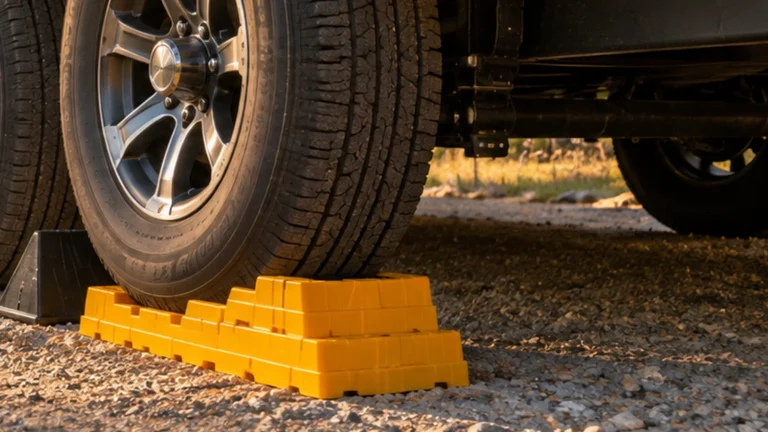
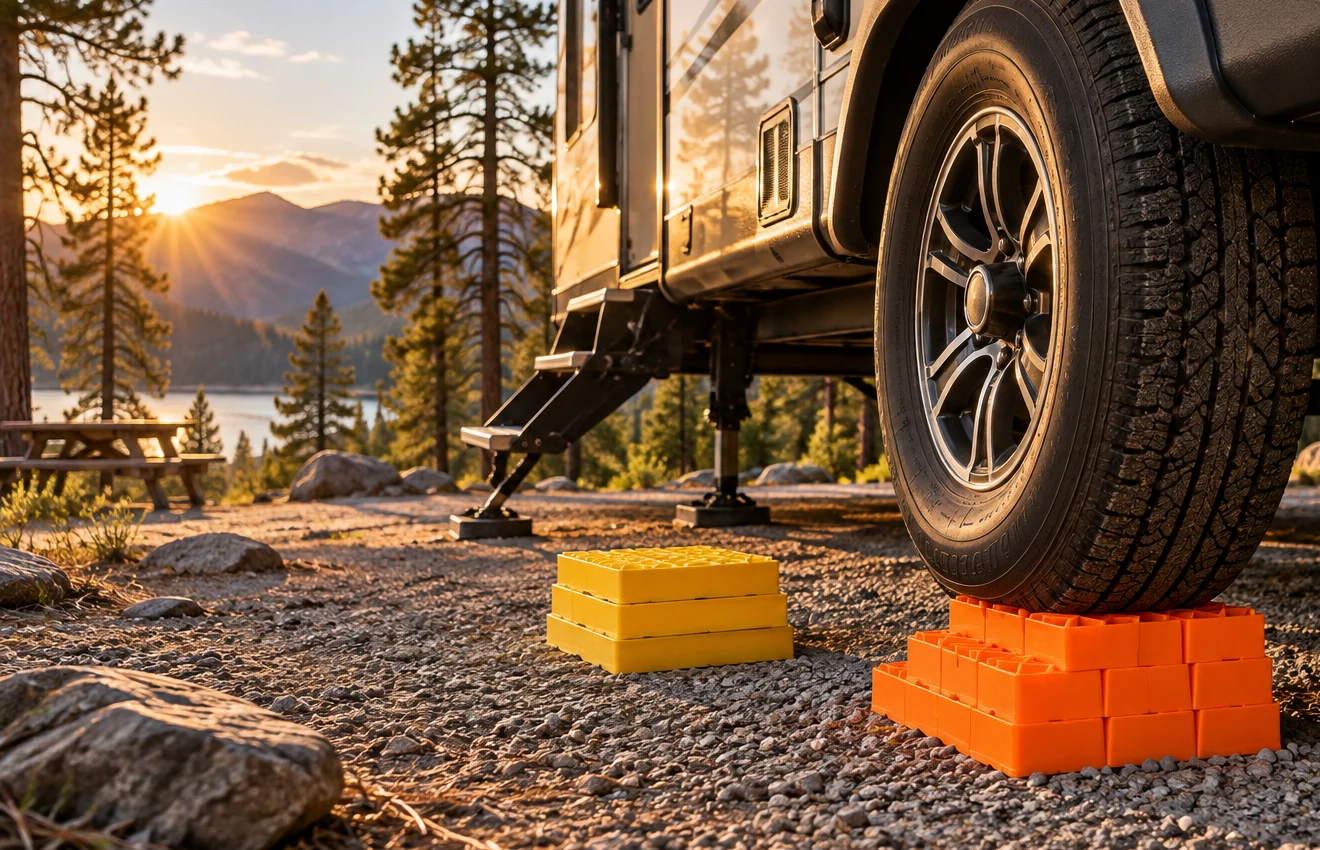
Best for: An owner who wants one modular block system for RV wheels and properly approved support under jacks. Tri-Lynx documents an 8.5-by-8.5-inch footprint, 1.5-inch physical block thickness, and approximately 1 inch of added lift when a block nests with another. It rates its Lynx Levelers system at 40,000 pounds and recommends stacking no higher than 5 inches. The official 10-block product comes in a nylon storage bag; the current Amazon listing for model 00015 is described as an 11-piece version with one cap, so confirm what ships.
The advantage is predictable increments and a manufacturer that actually publishes its stacking guidance. The cap is for a flatter support surface, not permission to build a taller tower. Orange blocks are also easy to find again when breaking camp.
Skip if: Your low side includes two tires that both require raised platforms and you also plan to use spare blocks under several jacks. A single starter set can run out long before the stack reaches its allowed height. You also need another approach if the ground is unstable or the necessary lift exceeds official limits.
Check Tri-Lynx 00015 availability on Amazon
2. Camco 44510: Best for a straightforward yellow block-and-bag kit
Best for: An RV owner who wants a compact, ten-piece interlocking kit with a zippered storage bag. Camco’s dealer description for part 44510 confirms that the blocks add approximately 1 inch per nested level and can be used for RV tires and certain jack applications. Unlike Tri-Lynx, its published dealer instructions specify a maximum of four stacked blocks for this exact part.
Why consider it instead of Lynx? The bright yellow color and bundled bag make it an easy kit to identify and put away. There is no verified evidence that it inherently lasts longer or carries more weight than Lynx, so those are not reasons to choose it. Do not confuse 44510 with similarly named Camco FasTen versions that add a twist-lock carrying handle.
Skip if: You need more than four blocks of stack height, cannot establish a firm base, or need a specific published load rating before supporting a heavier wheel position. Camco’s 44510 listings contain conflicting physical-thickness descriptions, so use the verified 1-inch lift per nested layer rather than treating the product title as a precision dimension for fit planning.
Check Camco 44510 availability on Amazon
3. Tri-Lynx 00014, 22-piece set: Best when you need more separate support points
Best for: Owners of tandem-axle trailers, or anyone planning to reserve blocks for more than one use position. The Amazon product identified as Tri-Lynx 00014 is a 22-piece bundle described as including 2 Lynx Caps. Its key advantage over a single starter set is the number of available pieces, not a different lifting mechanism.
Consider a tandem axle: if both tires on the low side need their own stepped path, the base of each ramp consumes several blocks before you add the next level. A ten-piece package that looks generous in the storage compartment can suddenly be short. Extra blocks let you build separate manufacturer-compliant supports, rather than bridging unsupported gaps with improvised pieces.
Skip if: Your small single-axle trailer usually needs only one or two shallow adjustments. You may not want to carry the larger kit. Also, never assume 22 pieces means that 22 blocks can be safely piled beneath one tire.
How many leveling blocks do you actually need?
Before buying, think in support positions, not merely inches of lift. Count every wheel that must be raised, then decide whether the tongue jack or stabilizer feet need separate pads. A tire ramp must have a properly supported approach, not just a stack directly under the contact patch.
| Your setup | What to plan for | What changes the answer |
|---|---|---|
| Single-axle travel trailer | Often one low-side wheel path plus separate parking chocks | The depth of the slope and any extra jack pads |
| Tandem-axle trailer | Two tire paths on the low side, properly supported for both tires | Wheel spacing, platform length, and number of stepped layers |
| Motorhome with dual rear tires | Support matching the full required tire contact area | Dual-tire geometry, axle load, block footprint, and maker approval |
| Automatic leveling-jack RV | Jack foot support, not automatically wheel-lifting ramps | The jack and RV manufacturer’s pad/load instructions |
This is why a larger quantity can be more useful than a taller possible stack. Build only the pattern allowed by the maker, and check that every tire carrying load stays fully supported. Do not interpret a gross vehicle weight claim as an unrestricted per-block rating on mud or gravel.
The five buying checks that prevent a bad fit
1. Real lift per layer, not the molded block thickness
Tri-Lynx specifies that a block 1.5 inches thick contributes 1 inch of lift when nested. Physical thickness and effective additional height are not the same number. For Camco 44510, the official dealer describes 1 inch of added lift per block. If you are trying to fix a small side-to-side lean, both systems adjust in steps, not continuously.
2. The manufacturer’s stack limit
Tri-Lynx recommends no more than a 5-inch stack for Lynx Levelers. Camco’s 44510 dealer guidance calls for no more than four stacked blocks. Those limits concern the arrangement and stability of the system, not just how many plastic pieces are in the bag. Do not extend the stack with rocks, bricks, or unmatched blocks to reach a higher tire.
3. Tire footprint and loaded position
Measure the portion of each tire that needs support, including both tires of a dual-wheel position where applicable. A square block that fits beneath one narrow trailer tire may not provide a suitable contact area for a wide tire or dual-wheel setup. Follow both the RV and block manufacturers’ load and support instructions; do not infer per-wheel capacity solely by dividing trailer GVWR by the number of tires.
4. Ground underneath the block
Firm, level ground is essential to a stable stack. A solid-looking plastic base may still sink into wet turf or shift on rounded stone. If the surface is visibly yielding, reposition the RV onto firmer ground or use a base solution expressly permitted by the equipment manufacturer. A wider board is not automatically safe just because it spreads the load.
5. Chocking and the type of jack
Leveling blocks raise a low wheel; wheel chocks restrain movement; stabilizers reduce rocking after the RV is level. They are different jobs. Use properly rated chocks according to your RV’s parking instructions, and never count a stabilizer or an between-tire stabilizing device as the sole parking brake or wheel chock. Ordinary stabilizer jacks are not substitute lifting jacks.
Three leveling-block mistakes that matter more than the brand
Building a narrow vertical tower beneath a tire
A wheel must be able to climb a stable, manufacturer-approved stepped approach and rest on a fully supported top surface. The stack should interlock as intended. Building height without sufficient base length trades convenience for instability. If the site demands a lift above the product’s documented limit, change the parking position or choose a different approved leveling solution.
Raising only one tire in a tandem-axle position
When the low side of a tandem trailer needs a lift, plan proper support for both tires on that side. Raising only one while leaving the other unsupported can distribute the load in an unintended way. Verify wheel spacing and clearance before deciding whether a stepped-block system fits your trailer.
Using jack pads as if they could level the chassis
Putting blocks beneath a stabilizer jack can shorten its extension or protect a suitable surface. It does not make that stabilizer a wheel-leveling device. For towables, side-to-side leveling is addressed at the tire positions before uncoupling, while front-to-back adjustment follows the RV manufacturer’s approved tongue-jack or landing-gear procedure.
When blocks are the wrong purchase
If you repeatedly need fine adjustments smaller than one block layer, curved drive-on levelers may be more convenient. They are a different product class with distinct tire-size, axle-spacing, ground-contact, and chock requirements. They are not a direct substitute for a set of square blocks under jacks, and their selection deserves its own comparison.
If your RV already has a manufacturer-approved automatic leveling system, check whether you need jack pads rather than wheel blocks. If the campsite is too uneven to stay inside safe block or jack limits, moving to a different spot is the better choice. No accessory makes unstable ground safe by itself.
Which set should you buy?
Choose the Tri-Lynx 00015 if you want a versatile starter set with clearly published lifting and stacking guidance. Choose Camco 44510 if you prefer its yellow interlocking blocks and bag, and your intended stack fits its four-block rule. Choose the Tri-Lynx 00014 bundle if you need enough pieces for multiple separate support points. Choose none of them if the tire footprint, site conditions, or required height falls outside the product’s approved use.
Our picks are based on model-specific manufacturer information, documented kit contents and the limitations that change a buying decision. They are not hands-on durability rankings. Check the exact Amazon variation and your RV’s parking instructions before purchasing.
Frequently Asked Questions
Are leveling blocks necessary if my RV has stabilizer jacks?
Often, yes. Ordinary stabilizers are intended to reduce movement after the RV is already level, not lift wheels or correct a large side-to-side tilt. A towable that is low at the wheels may still need approved tire-leveling blocks even when all four stabilizers are installed.
Will one ten-pack cover a tandem-axle travel trailer?
Not necessarily. A tandem axle may need two separately supported tire paths on the low side, and a stepped approach uses more pieces than the final platform height suggests. Plan the geometry and any jack pads before purchase, then stay within the manufacturer’s stacking limit.
Can I mix Camco and Tri-Lynx blocks in the same ramp?
Do not assume mixed brands will interlock safely. Their molded connection patterns and height profiles may differ, even when both are described as 1-inch-lift systems. Use a manufacturer-approved stack of matching blocks for the tire path instead of improvising a hybrid tower.
Why do plastic RV leveling blocks sink or crack?
Possible contributors include soft or uneven ground, point loading, a tire that does not fit the platform, excessive stacking, or blocks that are already damaged. A product’s headline weight rating does not eliminate those constraints. Stop using deformed or cracked pieces and check the maker’s support guidance before the next setup.