
GearAndRig is reader-supported. As an Amazon Associate I earn from qualifying purchases. When you buy through links on our site, we may earn an affiliate commission, at no extra cost to you. Learn more.
For many RVs, 40 to 50 PSI is a sensible starting range for city water. Some modern rigs permit higher pressure, but 60 PSI is not a universal safe limit. Check your RV owner’s manual and any city-water-inlet label before setting a regulator. If you cannot confirm the limit, do not increase pressure just to improve a weak shower.
What water pressure should an RV have?
An RV connected to a campground spigot needs enough pressure to feed its fixtures, but not more than its plumbing and appliance connections are rated to handle. The allowable inlet pressure is the important number, not the highest setting printed on an adjustable regulator.
There is real model-to-model variation. For example, the 2026 Grech RV Vacanza-ion owner’s manual recommends a regulator setting of 40 to 50 PSI and describes 50 PSI as the upper operating pressure for the plumbing it covers. Airstream’s touring-coach support guidance describes a built-in water regulator limited to 50 PSI. These are manufacturer-specific examples, not evidence that every motorhome, fifth wheel, and trailer has the same rating.
| Reading at the regulated connection | How to interpret it | What to do |
|---|---|---|
| Below 40 PSI | May be adequate for one fixture but can feel weak, especially with restricted flow. | Check the campground supply and restrictions. Do not assume that turning the regulator up will create pressure the spigot cannot provide. |
| 40 to 50 PSI | A common practical setting for many RV city-water hookups. | Use it only if within your RV’s stated limit and the fittings are sound. |
| Above 50 to 60 PSI | Acceptable on some systems, excessive on others. | Confirm your exact model permits it. Never use 60 PSI as a blanket rule. |
| Above your RV’s published limit | Too high regardless of whether the shower feels better. | Reduce the regulated pressure before using the water system. |
The useful decision: start with the coach manufacturer’s figure. A pressure range from an accessory package or a generic RV article cannot override the RV’s own limit.
How to find the maximum water pressure for your RV
Look under City Water, Fresh Water, Plumbing, or Water System in the manual for your RV’s exact model year and floor plan. Check the city-water connection for a pressure label and confirm whether the inlet already contains a regulator. If the manual is silent or the RV has been modified, contact the manufacturer or a qualified RV service technician rather than guessing.
Age matters, too. An older trailer may have fittings, repair sections, or connections that differ from current-production plumbing. Even a newer RV can develop leaks at a loose fitting. Neither the type of plastic pipe alone nor a pressure rating on one replacement component proves the entire assembled system is safe at that pressure.
If you find conflicting numbers, respect the lower applicable rating while you verify the issue. The number shown on your hose, filter, regulator, or water heater describes that component; the complete installation is limited by its least capable part.
How to check and set campground water pressure
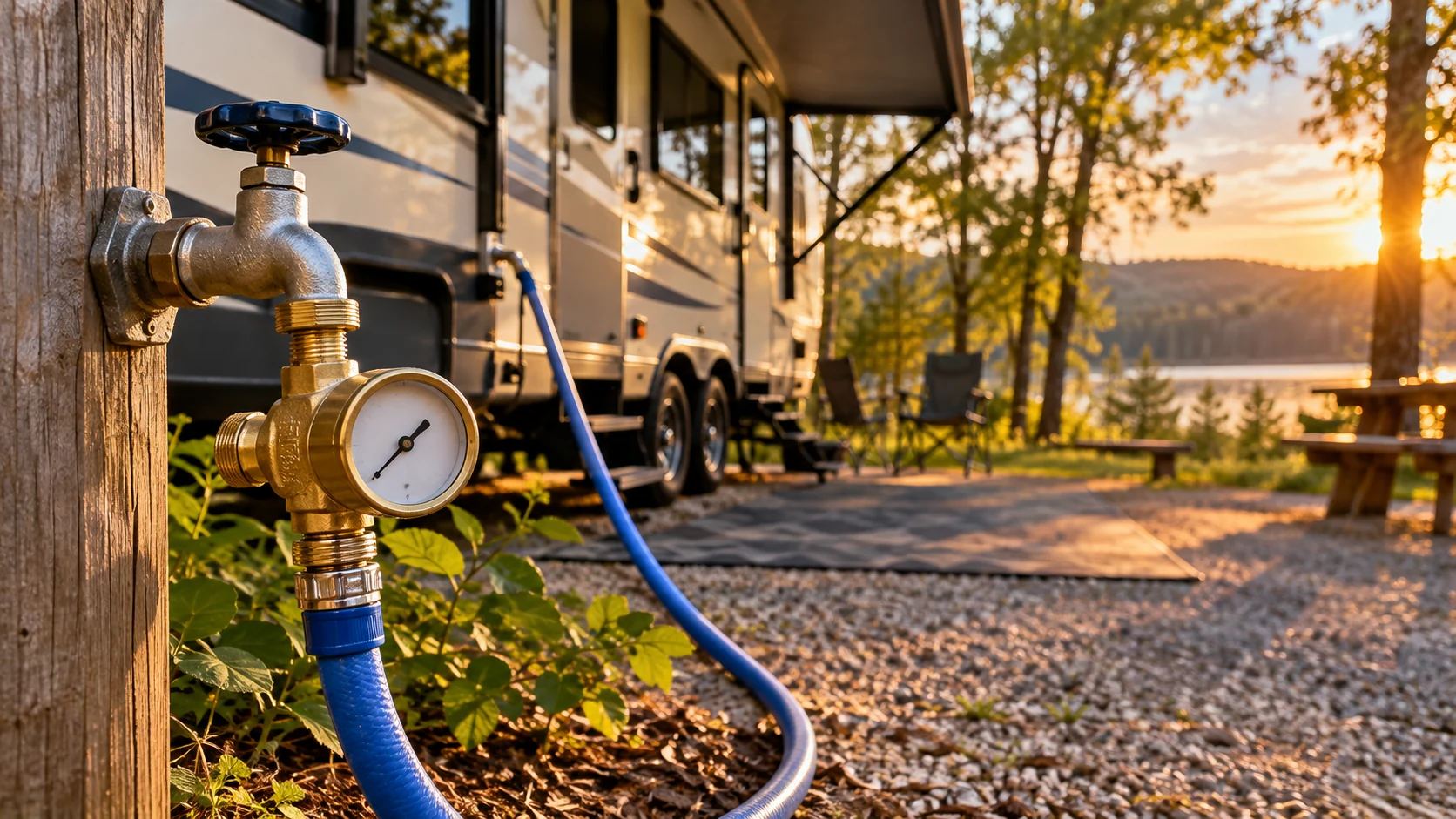
Use a regulator made for potable RV water hookups, and set it according to its own instructions. A gauge helps you see the outlet pressure, but a gauge by itself does not reduce it.
- Confirm the RV’s limit first. Check the manual before adjusting anything. Inspect the spigot, hose washers, filter housing, and city-water inlet for damage or leakage.
- Install the regulator upstream of the RV. Where the fitting layout permits, connect it at the campground spigot, followed by a drinking-water-safe hose and any compatible filter. This places the hose and accessories downstream of the pressure control. Follow the specific filter and regulator instructions if their order or supported pressure differs.
- Open the supply slowly. For an adjustable regulator, follow its setting procedure and read the regulated outlet gauge. Many regulators show static pressure when every faucet is closed. Recheck the reading with a faucet running if your regulator’s instructions call for that.
- Verify the result inside. Open a faucet to purge air and confirm normal operation. Watch hose ends, the city-water inlet, and visible plumbing for drips. If you discover a leak, shut off the spigot and relieve pressure before inspecting it.
A quick glance at a campground spigot’s gauge is not a substitute for checking what enters the RV after the regulator. Some inlet assemblies have built-in pressure reduction, so check the rig’s plumbing documentation before adding or adjusting equipment.
Why 50 PSI can still give you a weak RV shower
Pressure and flow are not interchangeable. PSI measures the force available to move water; flow describes how much water actually gets through. A gauge can show normal pressure while a narrow passage limits flow as soon as you open the shower.
Suppose the regulator reads 48 PSI with all faucets closed, but the shower loses strength when someone turns on the sink. Raising the regulator above your RV’s limit is the wrong diagnostic shortcut. First look for restrictions the owner can inspect safely: a kinked potable-water hose, a partly closed supply valve, a dirty inlet screen, a loaded water-filter cartridge, or a clogged showerhead. The filter and regulator themselves can also become the limiting parts of the hookup.
To narrow it down, compare one fixture with several fixtures running, and note whether the problem is new at this campground or happens everywhere. If the problem is isolated to one fixture, its aerator or showerhead is a more useful starting point than the campground setting. If every fixture slows dramatically together, the restriction may be farther upstream.
If a system leaks at a setting allowed by the manual, repair the leak; do not treat a lower regulator setting as proof the damaged connection is fixed. For persistent restrictions or plumbing repairs inside walls, use an RV service professional. This article is about the proper pressure target, not a full low-water-pressure troubleshooting procedure.
What equipment actually helps control the pressure?
For a pressure limit you already know, a fixed regulator is often enough. An adjustable model with a gauge is helpful when you regularly change campgrounds and want to see the actual setting. Neither device makes an undersupplied campground deliver more water.
Fixed, simple: Camco 40055 brass RV regulator
Camco lists this drinking-water-safe regulator as preset to 40 to 50 PSI. Its standard garden-hose-thread connections make it a straightforward choice for an RV whose manual permits that range. There is no knob or gauge for fine adjustment, which is the trade-off: you get a fixed target rather than a visible, custom setting.
Skip it if: your RV requires a lower maximum, you need a different connection type, or you need an outlet-pressure reading rather than a fixed preset.
Adjustable, visible setting: RVGUARD knob regulator with gauge
RVGUARD’s adjustable-knob version provides a gauge and inlet screen, useful if you need to set and recheck a model-specific pressure. The extra control also means you must verify the chosen pressure against the RV manual instead of relying on a factory preset. A gauge cannot fix a restricted water filter or low incoming pressure.
Skip it if: you prefer a set-and-forget 40 to 50 PSI regulator and do not need to change the setting, or your hookup cannot support its hose-thread connections.
Both products control incoming city-water pressure. If you are camping from the fresh-water tank, pressure is governed by the RV’s onboard pump and its controls instead. Check the pump’s exact manual before changing any pressure-switch setting.
A practical pressure rule for your next hookup
Write your RV’s manufacturer-approved maximum in your setup checklist. When you arrive, connect a potable-water regulator before admitting campground pressure to the coach, set it within that limit, and inspect for leaks. If the shower is disappointing despite an acceptable reading, investigate flow restrictions instead of immediately increasing PSI. One verified number for your own RV is worth more than a universal campground rule.
Frequently Asked Questions
Is 60 PSI safe for every travel trailer or fifth wheel?
No. Some RVs may permit pressure near that figure, while other manufacturers specify lower limits. The Grech RV example discussed above recommends 40 to 50 PSI. Check the manual for your precise RV model, including any modified fittings or accessories, before moving above its stated limit.
Do I still need a regulator if the campground reads only 35 PSI?
Low pressure at one moment does not establish that the supply will stay there. A compatible regulator can remain part of the hookup to limit higher incoming pressure if it rises later. It cannot boost a 35 PSI supply to 50 PSI; investigate the source and restrictions if flow is inadequate.
Does a city-water regulator change the pressure from the RV’s onboard pump?
No. A regulator connected to the campground water inlet controls water arriving through that connection. The fresh-tank pump has its own operating pressure and switching behavior. Consult the pump and RV manuals before altering its settings or combining pump operation with a city-water hookup.