
GearAndRig is reader-supported. As an Amazon Associate I earn from qualifying purchases. When you buy through links on our site, we may earn an affiliate commission, at no extra cost to you. Learn more.
For RV owners who want to see and control campground water pressure, the Renator M11-0660R is our first choice: it combines a screwdriver-adjustable valve with a liquid-filled gauge. The Camco 40055 is the simpler pick if you want a fixed 40-50 PSI regulator and no gauge to monitor. Choose neither until you check the pressure limit in your RV’s own manual.
Which regulator should you buy?
Start with how you actually use city-water hookups. A fixed regulator protects against excessive pressure without asking you to choose a setting. An adjustable regulator adds control and a gauge, but makes you responsible for setting a pressure your RV can tolerate. The gauge is useful, not a substitute for checking the manual.
Liquid-filled gauge, screened inlet, and screwdriver adjustment. Choose it when you want an easily visible set point.
A compact lead-free brass regulator preset to 40-50 PSI, without a gauge or adjustment step.
Preset 40-50 PSI regulation with a color-coded dial for an at-a-glance reading.
An adjustable brass design with a hand-operated knob and gauge. Useful when you change hookups frequently.
Important exception: Some coaches already have a built-in water pressure regulator. Airstream, for example, documents a built-in 50 PSI regulator on certain touring coaches. Identify the plumbing arrangement in your specific model before buying an external one or assuming your hose is protected.
RV water pressure regulators compared
The differences below come from the manufacturers’ published product information, not flow-bench testing. All four are intended for a standard RV-style garden-hose connection, but the direction of the fittings and the actual connection on your rig still need checking.
| Model | Control and reading | Pick it if | Think twice if | Amazon |
|---|---|---|---|---|
| Renator M11-0660R | Adjustable screw; liquid-filled gauge; inlet screen | You want visible, adjustable pressure at changing campgrounds | You want a simple fixed regulator or no adjustment tool | View |
| Camco 40055 | Factory fixed at 40-50 PSI; no gauge | You know that preset fits your rig and prefer simplicity | You need to see the pressure or alter the set point | View |
| Camco 40064 | Factory fixed at 40-50 PSI; color-coded gauge | You want a reading without another adjustment decision | You expect a gauge to make the valve adjustable | View |
| RVGUARD knob version | Adjustable knob; gauge; screened inlet | You want to adjust without carrying a screwdriver | You could inadvertently change the setting when handling it | View |
Best for: monitored adjustment. Trade-off: screwdriver required.
Best for: fixed-pressure simplicity. Trade-off: no gauge.
Best for: fixed pressure plus a visible reading. Trade-off: no adjustment.
Best for: tool-free adjustment. Trade-off: setting needs checking after handling.
The four models worth considering
Renator M11-0660R
Choose it for a monitored set point, not because an adjustable regulator automatically gives you a stronger shower.
The manufacturer describes a brass body, a silicone-oil-filled gauge, standard 3/4-inch garden-hose threading and a screened inlet. That combination makes practical sense when one campsite supplies a comfortable flow and the next does not. You can read the gauge and make an adjustment within the limit set by your RV manufacturer.
The oil filling is intended to damp gauge movement. It is not proof of greater pressure accuracy or higher water flow. Renator advertises a large adjustment capability; that figure belongs to the regulator mechanism and must never be interpreted as an allowable RV plumbing pressure.
Good fit if
- You want to see the setting each time you connect.
- You are comfortable following the regulator’s adjustment instructions.
Skip if
- Your RV requires a lower output than the intended setting can reliably provide.
- You want a fixed device that needs no tool or follow-up setting check.
Camco 40055
A sensible default if your RV manual permits its 40-50 PSI preset and you do not need a pressure reading.
Camco specifies lead-free brass, outdoor use and standard garden-hose connections. The uncomplicated design removes one recurring campground task: there is no screw or knob to reset. That makes it particularly convenient for occasional travel-trailer trips and owners who do not want another dial to interpret.
You give up visibility and control. If water seems weak, you cannot distinguish a restrictive regulator from a clogged screen, narrow hose, filter or low campground supply by looking at this device alone. And a factory band of 40-50 PSI does not replace your own RV’s stated limit.
Good fit if
- Simple, compact protection is your priority.
- You have confirmed the preset pressure is acceptable.
Skip if
- You need to monitor the delivered pressure.
- Your particular coach specifies a lower maximum.
Camco 40064
The middle option for owners who want to read pressure but not adjust the factory setting.
Camco lists a color-coded gauge, drinking-water-safe lead-free brass and a 125 PSI maximum incoming pressure for the 40064. Unlike Renator and RVGUARD, this is still a fixed regulator. The gauge helps you spot an unexpected reading, but it cannot change the output by itself.
That distinction matters: a buyer who specifically wants to fine-tune water pressure should not buy a fixed gauge-equipped model by mistake. The gauge also adds an exposed component to protect when packing the hose kit. Respect the stated inlet rating; if your supply exceeds the device’s rating, this is not a suitable connection.
Good fit if
- You want a visible reading with a factory preset.
- You prefer not to adjust the valve.
Skip if
- You need to change outlet pressure.
- Your incoming supply exceeds the regulator’s manufacturer-rated limit.
RVGUARD Adjustable Knob Regulator
Choose this specific knob version when convenient setup matters more than a screwdriver-actuated adjustment.
RVGUARD sells both screwdriver-adjustable and knob-adjustable brass regulators. This pick is the knob model, not the visually similar screwdriver type. Its published features include a gauge and an inlet screen, with the hand-operated control intended for adjustments without a tool.
The convenience creates one extra habit: check the gauge after installation and again if the knob may have been bumped in storage. The manufacturer’s material and compliance statements are useful purchasing evidence, but this guide does not treat a product-page claim as independent laboratory certification.
Good fit if
- You hook up frequently and dislike using an adjustment tool.
- You are willing to verify the reading after connection.
Skip if
- You prefer a setting that cannot easily be changed by hand.
- You are looking at the screwdriver version by mistake; confirm the knob before ordering.
Do not confuse water pressure with shower flow
A regulator controls pressure. Your shower experience also depends on the amount of water the campground supply can deliver through the entire setup. Hose diameter and length, restrictive fittings, partially open valves, sediment-filled screens and inline filters can each affect flow. A gauge reading does not establish a product’s flow rate.
Winnebago’s published water-regulator discussion specifically separates pressure protection from flow-rate performance. However, comparable independent flow curves are not available for all four models here. Ranking them by a claimed gallons-per-minute advantage would be misleading.
If a shower goes weak after adding a regulator, avoid immediately turning an adjustable unit higher. First check whether the campground faucet is fully open and whether the inlet screen is blocked. If the RV uses an inline water filter, check its condition and rated flow, then inspect the drinking-water hose for kinks. Compare behavior at another known-good hookup if available. Persistent low flow with otherwise appropriate pressure belongs in your RV’s plumbing troubleshooting, not a guessing game with the screw.
What to check before your first hookup
- Find the actual RV pressure limit. Consult the water-system instructions for your model and year. Winnebago documentation commonly recommends pressure controlled to 50 PSI maximum, but that is not a universal specification for every RV.
- Check for an existing regulator. Some RVs have one built into the city-water system. An extra external regulator may still be relevant for protecting the supply hose, but the plumbing layout and limitations must guide that choice.
- Confirm the fitting and rating. These products use common 3/4-inch garden-hose connections. Verify the mating threads, gasket condition, water-use suitability, inlet rating and space around the campground spigot.
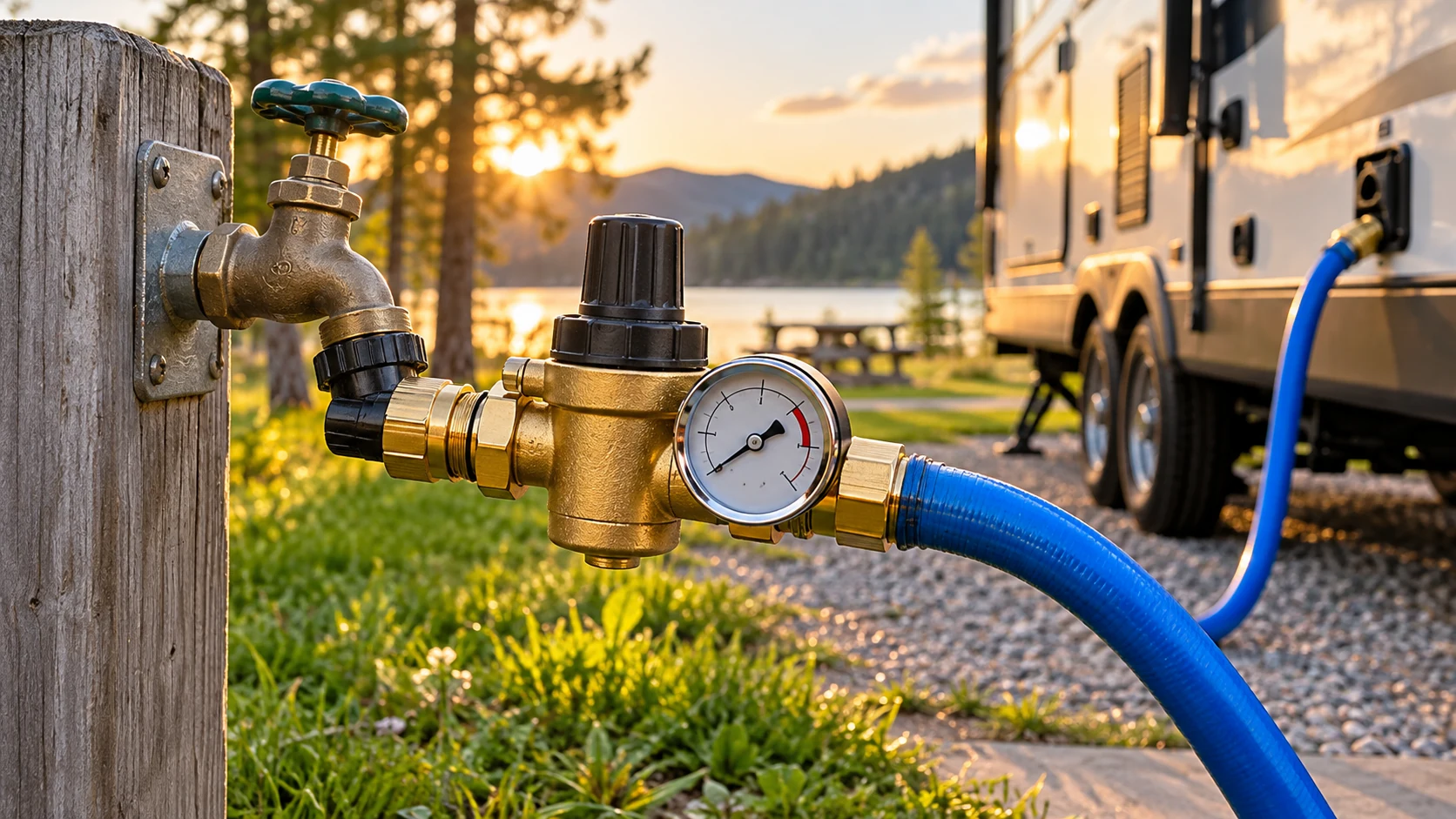
- Place the regulator upstream when appropriate. The typical campground arrangement is spigot, regulator, potable-water hose and RV city-water inlet. Fitting the regulator at the spigot also limits pressure reaching the hose; observe the product’s flow direction and exact instructions.
- Bring the water on slowly and inspect for leaks. Follow the RV’s city-water and air-purging instructions. On adjustable models, confirm the downstream reading using the manufacturer’s adjustment procedure, with the RV limit as the controlling value.
Do not turn a regulator up to its advertised maximum. A range advertised by a valve manufacturer describes what the device can be adjusted to, not what RV faucets, lines, appliances or connectors can withstand. Stop using a damaged, leaking or frozen regulator rather than trying to repair an unknown internal valve.
Three easy buying mistakes
Buying a gauge when you actually need adjustment. Camco 40064 shows a reading but maintains a factory preset. A gauge-equipped product is not automatically adjustable.
Assuming the gauge displays campground supply pressure. A regulator-mounted gauge is intended to help monitor pressure at its measurement point. Without a separate upstream measurement, do not infer the unregulated pressure from the displayed number. Nor can it tell you how many gallons per minute reach the shower.
Choosing by brass color or the largest advertised PSI number. Check the exact part number, lead-content documentation, hose-thread fit, adjustment method, manufacturer instructions and the pressure limit for your RV. An inlet screen catches coarse particles; it does not replace a potable-water treatment filter.
How these recommendations were made
These are desk-research recommendations based on current model-specific manufacturer product pages and instructions, RV manufacturer guidance, and Amazon.com listing identities. The picks are separated by distinct buyer jobs: fixed simplicity, fixed with a gauge, screwdriver-adjustable with a liquid-filled gauge, and tool-free adjustable. We did not conduct hands-on pressure or flow testing and do not assign numerical performance scores. Availability and product variants can change, so check the exact listing before ordering.
The practical verdict: Choose Renator if you will actively monitor and adjust pressure, Camco 40055 if a verified fixed 40-50 PSI output is all you need, Camco 40064 if you want that preset plus a gauge, or the RVGUARD knob version if you frequently adjust without tools. Choose none of them until your RV’s allowable pressure and built-in protection are clear.
Frequently Asked Questions
Do I still need an external regulator if my RV has a built-in one?
Not automatically. Some models already regulate the pressure reaching the RV plumbing, as Airstream documents for certain coaches. An upstream external regulator may protect the drinking-water hose as well, but first check your model’s water-system instructions and identify where its built-in regulator is located.
Does an RV water pressure regulator go at the spigot or at the trailer?
For a typical city-water hookup, placing it at the campground spigot reduces pressure before the water enters the hose and RV. The Renator installation guide describes this arrangement. Check the directional marking, threads and model-specific setup before turning on the water.
Will an adjustable regulator improve a weak RV shower?
Not necessarily. It cannot create pressure or water volume that the campground source does not provide. A dirty inlet screen, clogged water filter, kinked hose or restrictive connection can also reduce flow. Check those first, and never raise the pressure above the limit in your RV manual to compensate.
Is a 160 PSI gauge or adjustment range safe for an RV?
No such conclusion follows from the number printed on a regulator. Gauge scale, allowable incoming pressure, adjustment capability and safe pressure for your RV are different specifications. Follow your vehicle’s published maximum, and also stay within the pressure and use limits of the regulator itself.