
GearAndRig is reader-supported. As an Amazon Associate I earn from qualifying purchases. When you buy through links on our site, we may earn an affiliate commission, at no extra cost to you. Learn more.
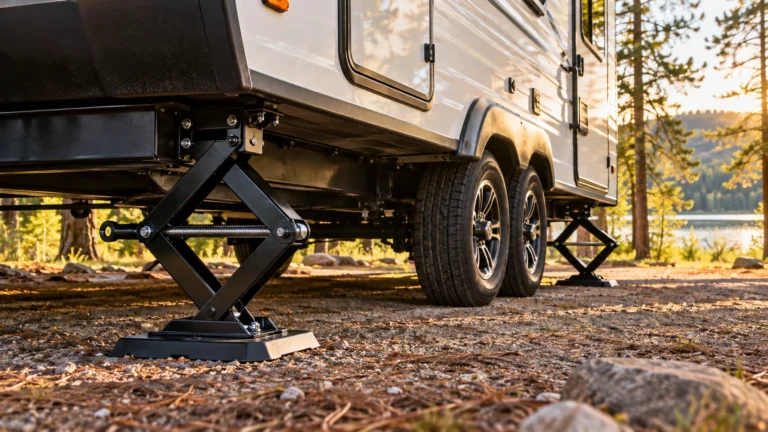
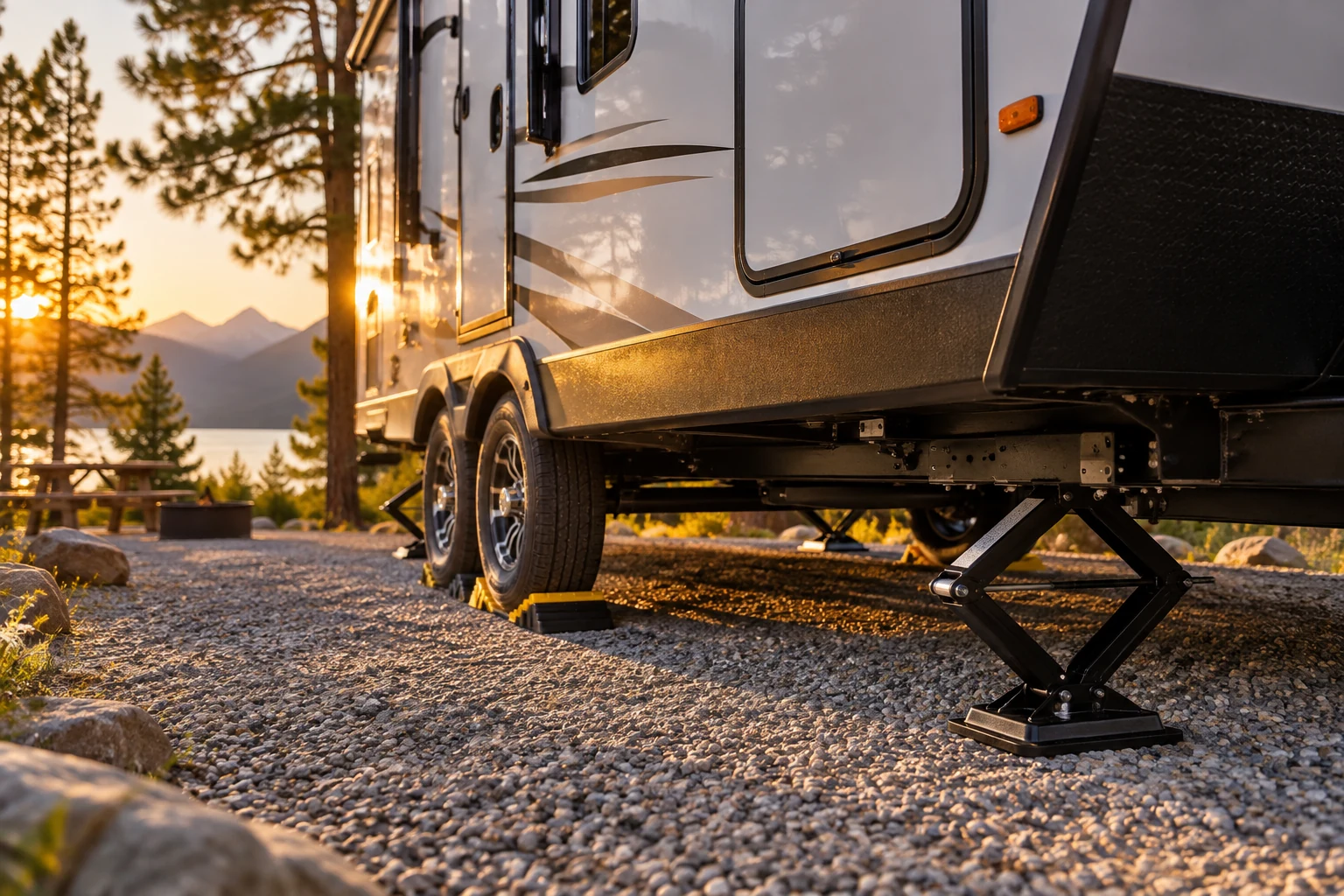
RV stabilizer jacks and leveling jacks do different jobs. Leveling changes the RV’s height or angle; stabilizing reduces movement after it is level. On a typical travel trailer, level side to side with tire-supported blocks or ramps, adjust front to back with the tongue jack, and only then lower the stabilizers. Do not use ordinary scissor stabilizers to lift the trailer.
Stabilizer Jacks vs. Leveling Jacks: What Actually Changes?
The distinction is the load the equipment is designed to manage, not whether it has a crank, motor, or a jack-shaped frame. A corner stabilizer can touch the ground and feel solid without being designed to change the trailer’s attitude. A purpose-built leveling jack or system, by contrast, is engineered to raise a supported portion of the RV within its operating limits.
| Question | Typical stabilizer jack | Purpose-built leveling jack/system |
|---|---|---|
| Primary job | Limit rocking and bounce while parked | Correct side-to-side or front-to-back tilt |
| When used | After the RV has been leveled and secured | During the leveling stage, following the RV/system manual |
| What supports the RV | The tires, suspension, tongue jack or approved landing gear remain the primary supports | Rated lifting/support points work as specified by the installed leveling system |
| Typical equipment | Manual scissor stabilizers, power stabilizer assemblies | Motorhome hydraulic/electric leveling systems, approved fifth-wheel/trailer leveling systems |
| Critical limitation | Not a tire-changing or frame-lifting jack | Not automatically a tire-changing jack either; maintenance lifting requires separate authorization and support |
Stabilizers: Limit rocking and bounce after parking. Leveling systems: Correct side-to-side or front-to-back tilt.
Stabilizers: After the RV is level and secure. Leveling systems: While the RV is being leveled according to its manual.
Stabilizers: Tires, suspension and designated supports remain primary. Leveling systems: Purpose-built rated supports at the system’s authorized points.
Stabilizers: Manual scissor or power stabilizer assemblies. Leveling systems: Approved hydraulic/electric RV or fifth-wheel systems.
Ordinary stabilizers are not lifting jacks. A leveling system is not necessarily approved for tire changes or maintenance lifting.
The fast test: if the manual calls the component a stabilizer and warns against lifting or leveling, it cannot replace leveling equipment, no matter how much force the handle seems capable of producing. Lippert’s Scissor Jack Aftermarket instructions expressly describe its scissor jacks as stabilizing components only.
Why the Words on the Product Box Can Mislead You
Some retail descriptions call a scissor unit a “leveling stabilizer jack.” That language does not override the operating instructions. For example, the LIBRA 30-inch scissor-jack listing uses both words, while its own warning says not to lift a vehicle, change a tire, or support the vehicle’s weight. Its printed capacity is not permission to unload a trailer axle.
There are genuine exceptions. BAL’s published guidance covers certain purpose-designed QTG and SJ leveling-jack systems that can make permitted height corrections. That does not turn every BAL-branded jack, or every aftermarket scissor jack, into a leveling system. Identify the exact series, mounting arrangement, supported RV type, operating limits and manual before treating any jack as a leveler.
The Correct Order for a Conventional Travel Trailer
For a trailer without an integrated automatic leveling system, the normal distinction becomes obvious during campsite setup. Follow the sequence specified in your trailer manual, including the manufacturer’s requirements for the hitch, tires and wheel chocks.
- Choose an appropriate parking position and assess the slope. Avoid trying to compensate for a dangerously sloped or unstable site with taller stacks or extra jack pressure.
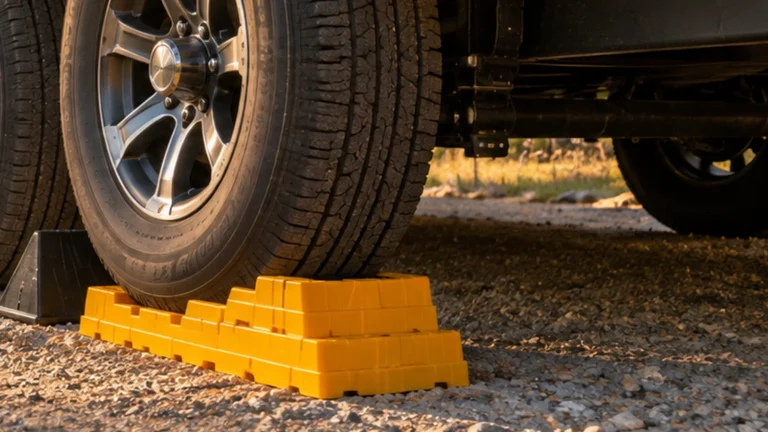
- Establish side-to-side level at the tires. Use approved interlocking leveling blocks or a compatible drive-on leveler while the trailer is positioned as required by its instructions. Keep tires properly supported.
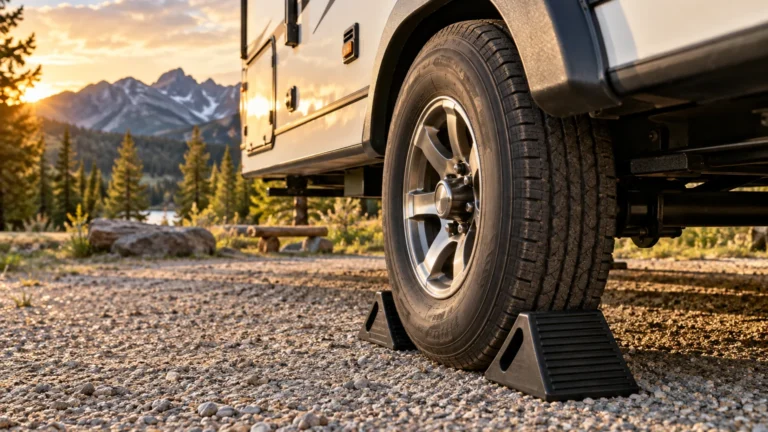
- Secure the wheels, then establish front-to-back level. Chock according to the trailer’s instructions and use the designated tongue jack or fifth-wheel landing gear for the permitted adjustment. Do not rely on an X-chock as a replacement for primary wheel chocks.
- Deploy the stabilizers last. Bring their feet into the intended ground contact, using rated pads where conditions require them. Stop at the pressure or control indication specified by the stabilizer manufacturer rather than using the jacks to raise a low corner.
If a motorhome or fifth wheel has an OEM or aftermarket auto-leveling system, its own parking, brake, suspension, hitch and leveling sequence takes precedence. The travel-trailer steps above are not instructions to bypass that system.
Which Equipment Solves Your Problem?
These options are not three competing brands of the same tool. They solve different parts of a campsite setup. Choose by the job that is missing before choosing a product.
| Example product | Use it when | What it does not do | Amazon |
|---|---|---|---|
| Camco 44510, 10-pack leveling blocks | You need adjustable side-to-side tire support or a compatible support base | Does not damp trailer movement by itself | Check on Amazon |
| Andersen 3604 Camper Leveler | You want a curved drive-on tire-leveling method that suits your wheel spacing and clearance | Does not replace corner stabilizers or chocking procedures | Check on Amazon |
| LIBRA 30-inch scissor stabilizers, pair | Your compatible trailer needs replacement/additional stabilization after leveling | Must not be used as a vehicle-lifting or tire-service jack | Check on Amazon |
For: Tire-supported side-to-side adjustment with modular blocks.
Not for: Eliminating rocking by themselves.
For: Curved drive-on wheel-leveling on compatible tires and sites.
Not for: Replacing stabilizers or approved wheel chocks.
For: Reducing movement after the RV has been leveled.
Not for: Raising tires, tire service or vehicle-weight lifting.
Camco 44510 blocks: for tire-supported height correction
Camco’s interlocking blocks are a modular approach to wheel leveling. The 44510 is a 10-pack with a storage bag. The product instructions specify approved stack arrangements and warn against stacking beyond their stated limit. The blocks help when a low tire needs height, but the trailer can still move as occupants walk around.
Choose these when you want a reusable support system and have enough blocks for the tire footprint and approved stacking configuration. Skip them if the problem is bounce in an already-level RV; that’s a stabilization issue, not a tire-height issue.
Andersen 3604: for drive-on tire leveling
The Andersen 3604 combines a curved leveler with a matching chock. It can make side-to-side corrections as a wheel rolls onto the ramp, provided the product fits the trailer’s tires, axle spacing, clearance and terrain. Unlike loose blocks, this design changes height continuously as the wheel moves along the curve.
Choose this style if fine adjustments at a suitable site matter more than modular stacking. Skip it if the ramp and chock cannot be positioned or secured as the instructions require, particularly with close-spaced tandem tires. It does not authorize lifting the vehicle for service.
LIBRA 30-inch scissor stabilizers: for movement after leveling
The LIBRA 30-inch pair is a steel scissor-style stabilizer product, sold with adjustment accessories and mounting hardware in the identified Amazon listing. It is not a substitute for wheel leveling. Check the actual retracted clearance, attachment points, extension needed on your site, and the RV manufacturer’s subframe requirements before selecting replacement units.
Choose these if your existing stabilizers are missing, damaged or unsuitable and this exact assembly is compatible with the RV. Skip them if you’re trying to correct a low tire, support a disconnected axle, or make a tire change. A stronger-looking scissor jack cannot fix those problems safely.
Amazon listings can change by seller and variant. Confirm the model number and current offer before ordering, and use the applicable manufacturer instructions for installation and operation.
How the Answer Changes by RV Type
Travel trailer with four scissor stabilizers
Use tire-supported leveling equipment for left-to-right correction, the tongue jack for front-to-back adjustment, then the corner stabilizers for movement control. If a door begins binding while a scissor jack is being cranked, stop rather than forcing the handle. Excessive jack loading can distort the frame or body openings.
Fifth wheel with landing gear and rear stabilizers
The front landing gear has a different load-bearing role from rear stabilizers. Depending on the fifth wheel, leveling may be manual or managed by a dedicated multi-point system. Do not apply the conventional travel-trailer unhitching sequence to a fifth wheel with manufacturer-specific auto-level procedures.
Motorhome with hydraulic or electric leveling
An integrated system can be designed to make permitted height corrections through specified support points. Read its model-specific instructions for parking brake, suspension, ground conditions, jack pad use and operating limits. Calling every leg underneath a motorhome a “stabilizer” obscures these differences; identify the installed system before operating it.
What to Do When the Trailer Is Level but Still Rocks
First check whether the trailer is properly chocked, the stabilizers have made authorized ground contact, and their pads are sitting on firm support. An uneven soft pad or a leg that has settled into soil can leave the RV rocking even when the bubble level is centered. A level reading describes position, not resistance to movement.
Do not keep extending a scissor stabilizer until it starts jacking the frame upward. If the trailer noticeably tilts as you tighten one, you’re using it to change level, not simply stabilize. Retract and reset the equipment according to its instructions and correct the underlying setup with approved leveling gear.
If any stabilizer is bent, damaged, loose at the frame, or appears to be carrying load beyond its intended use, stop using it and arrange an appropriate inspection. Do not crawl beneath a vehicle that depends on stabilizers for support. If a tire has lost contact with the ground unintentionally, keep people clear and consult the trailer manufacturer’s recovery guidance or a qualified RV service professional rather than attempting a quick correction underneath the vehicle.
The Buying Decision in One Minute
If the RV is tilted, buy or use equipment approved to level it. If it is level but moves when someone walks inside, inspect and use the approved stabilizers. If you need both improvements, you may need both equipment classes. A high scissor-jack load rating does not make one product safely do both jobs.
Before ordering, identify your trailer and jack model, find its instructions, and check the frame mounting, ground clearance, wheel setup and allowed loads. That short compatibility check prevents a much more expensive mistake than buying the wrong accessory.
How This Comparison Was Researched
This is a document-based comparison, not a hands-on product test. It draws on Lippert’s published guidance and scissor-jack restrictions, BAL’s equipment-specific leveling instructions, manufacturer product details and current Amazon US listing identities. Product descriptions that use “leveling” loosely were checked against safety warnings. Site-specific RV manuals remain the final authority for permitted loads and procedures.
Frequently Asked Questions
Can I level a camper with four scissor stabilizer jacks?
Not with ordinary scissor stabilizers intended only to limit movement. They are not designed to substitute for tire-supported leveling or an approved lifting system. A purpose-designed jack that its manufacturer explicitly approves for leveling is a separate case; check the exact model and RV installation instructions before using it that way.
Why does my travel trailer rock even when the bubble level is centered?
The bubble level measures tilt, not how firmly the parked RV resists movement. Check primary wheel chocks, authorized stabilizer contact and whether feet or pads have settled into soft ground. Do not crank stabilizers harder to compensate for a tilted trailer or an unstable parking surface.
Does a 5,000-pound scissor jack rating mean it can lift my trailer for a tire change?
No. That rating alone does not authorize lifting an RV or supporting it while a person works underneath. Lippert’s scissor-jack instructions specifically prohibit using its stabilizers to level or service a trailer; LIBRA’s listed scissor product also warns against tire changes. Use only the tire-service lifting points and equipment specified by the RV manufacturer.
Do I still need wheel chocks if I have a leveling system?
Do not assume the leveling legs or a between-tire stabilizer prevent the RV from rolling. Follow the parking and wheel-chocking requirements for your exact RV and leveling equipment. A friction-style X-chock may reduce wheel movement on compatible tandem axles, but it does not serve as the primary chocks required by your trailer instructions.