
GearAndRig is reader-supported. As an Amazon Associate I earn from qualifying purchases. When you buy through links on our site, we may earn an affiliate commission, at no extra cost to you. Learn more.
For most travel trailers, the MaxxHaul 70472 solid-rubber chocks are the most versatile starting point: the two-pack has a wide-grip rubber body and integrated handles. Choose Camco 44471 if you have tires up to 26 inches and prioritize lightweight storage and pull ropes. For tires between 26 and 29 inches, consider the larger Camco 44492, but confirm your RV’s weight and the chock’s suitability before buying. Every option here is a ground-contact wedge. An X-chock is not a substitute.
Wheel chocks are an anti-roll safety item, not a cure for every unstable campsite. The important choice is less about how many stars a product has and more about tire fit, contact with the ground, storage needs, and the conditions in which you park. There is no verified universal incline or trailer-weight rating for the three models below, so none should be treated as suitable for an arbitrary steep grade or heavy commercial rig.
Three RV wheel chocks worth considering
- Most versatile for everyday trailer use: MaxxHaul 70472. A dense rubber wedge, 8 inches long, 4 inches wide and 6 inches high, supplied as a pair.
- Lightweight and easy to retrieve: Camco 44471. Two hard-plastic chocks with pull ropes; the manufacturer states a maximum tire diameter of 26 inches.
- Larger plastic wedge: Camco 44492 Super Wheel Chock. One larger wedge sold individually, with a stated tire-fit limit of 29 inches on its Amazon US listing.
If your tires exceed the advertised size, the site has a significant grade, or the RV is particularly heavy, do not assume any of these will work. Check your RV and chock manufacturers’ guidance and choose chocks with suitable documented capacities instead of trusting product labels such as “heavy duty.”
Compare the important differences
| Model | Material and pack | Verified fit detail | What makes it useful | Watch out for | Amazon |
|---|---|---|---|---|---|
| MaxxHaul 70472 | Solid rubber; 2-pack | 8 × 4 × 6 in. each; no universal RV weight/grade approval stated | Traction surface plus built-in handle | More storage weight; confirm appropriate tire/chock sizing | Check on Amazon |
| Camco 44471 | Hard plastic; 2-pack | Tires up to 26 in. diameter | Low carrying weight; retrieval ropes | Not for tires over 26 in. or heavy commercial applications | Check on Amazon |
| Camco 44492 | Plastic; single wedge | Tires up to 29 in. per Amazon US listing | Larger wedge than Camco’s standard chock | Sold one at a time; no universal heavy-RV rating given | Check on Amazon |
Rubber, pair. Choose for a tactile, substantial ground-contact wedge and handles; verify size and conditions.
Plastic, pair with ropes. Easy to stash, but only for tires up to 26 inches.
Larger plastic wedge, one per package. For tires up to 29 inches according to the listing; count quantities carefully.
What the table cannot tell you: “Solid rubber,” “heavy duty,” and a large wedge shape are not a verified load rating. We found product dimensions and stated fit limits, but not a single comparable manufacturer-certified maximum slope and parked-RV weight across all three. That missing data matters more than a speculative best-for-10,000-lb label.
Which one should you actually put in your trailer?
MaxxHaul 70472 solid rubber chocks, two-pack
A straightforward rubber wedge for RV owners who want a substantial, reusable pair instead of ultra-light plastic.
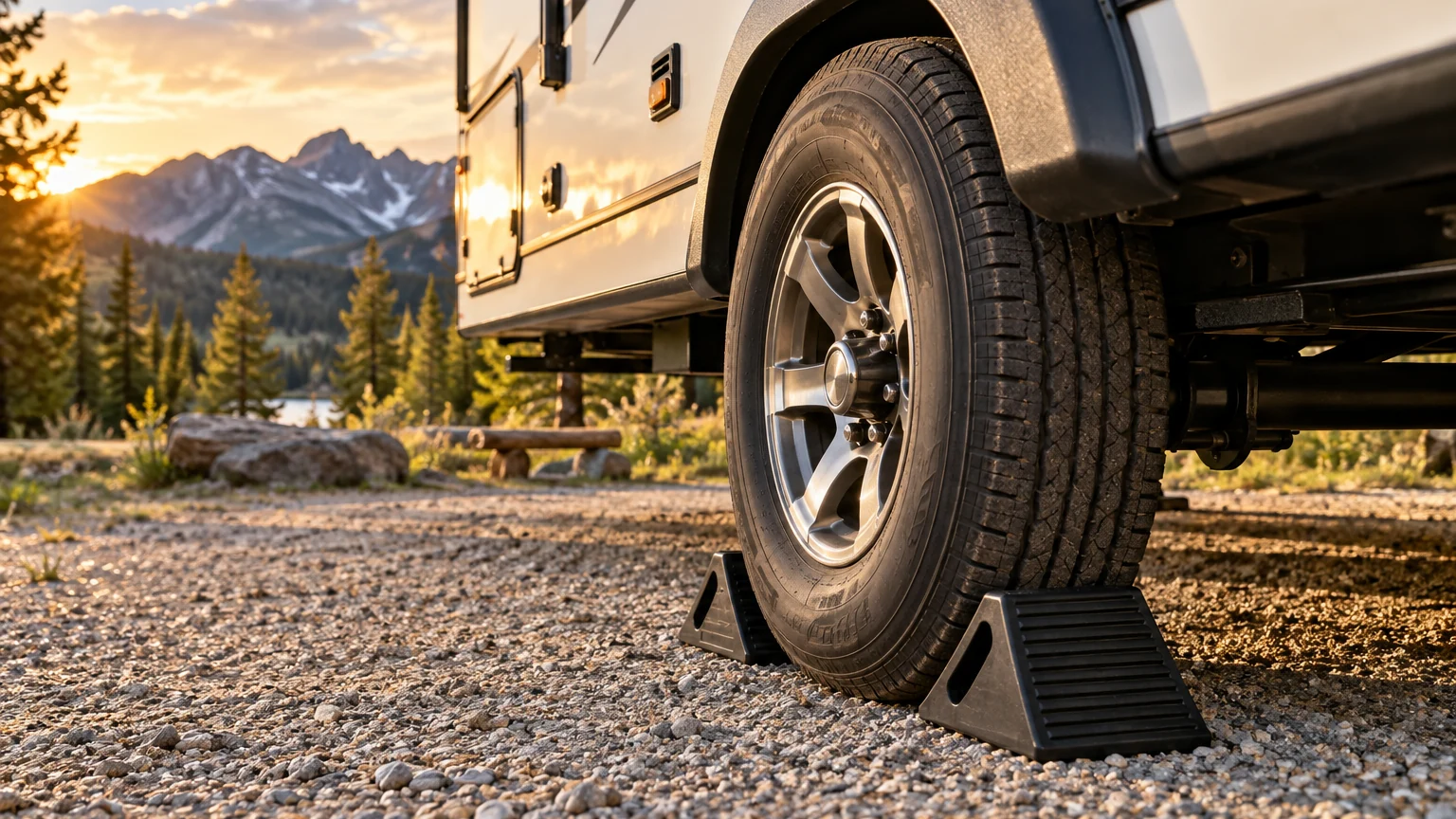
The manufacturer describes model 70472 as an 8-by-4-by-6-inch rubber chock with an integrated molded handle and traction pads. These are practical features for a frequently used travel trailer: the handle makes carrying easier, and rubber has some compliance against a firm ground surface compared with a rigid molded wedge. This is a design-based preference, not an independent claim that the product will grip every wet or soft surface.
The compromise is bulk and mass. The listed pair weighs roughly eight pounds, considerably more than Camco’s lightweight plastic set. The manufacturer also directs users to select chocks appropriate for their vehicles and to use them on firm ground. A 6-inch-high wedge must still be checked against the actual tire and use conditions; a dimension alone is not a load-capacity certification.
Choose it when
- You want a two-piece rubber set with integrated carrying handles.
- You park on firm pads and are willing to store a heavier pair.
Skip it when
- You need a documented capacity for a steep grade or an unusually heavy vehicle and cannot verify the applicable specification.
- You need the lowest possible storage weight.
Camco 44471 wheel chocks with rope, two-pack
A light, RV-specific pair for smaller tires and easier handling, provided the 26-inch tire limit works for your rig.
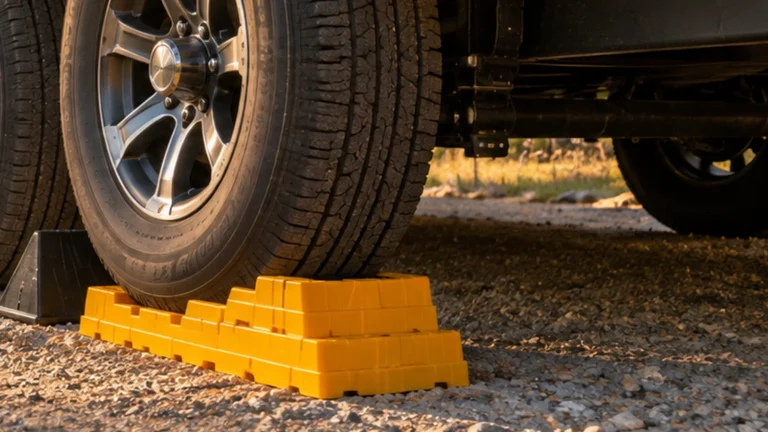
Camco makes the 44471 as a matched two-pack with a pull rope on each chock. If the blocks become snug against a stationary tire, the ropes make retrieval less awkward once the trailer is secured to the tow vehicle and the wheels are no longer loading the chocks. They are also easy to identify and pack in a small storage compartment.
The tire-diameter limit is decisive. Many 15-inch-rim trailer tires have an overall diameter greater than 26 inches, so do not assume that a tire marked “15” fits: rim diameter is not tire diameter. Read the tire sidewall, look up the exact overall diameter in that tire manufacturer’s specification, and compare it with Camco’s 26-inch limit. Camco also excludes heavy commercial trucks and trailers from the standard model’s intended use.
Choose it when
- Your tire’s verified outside diameter does not exceed 26 inches.
- You prefer a lighter pair with built-in retrieval ropes.
Skip it when
- You have 27-inch or larger tires, even if the wheel rim itself is 14 or 15 inches.
- You are relying on a general plastic wedge without a suitable specification for a demanding parking situation.
Camco 44492 Super Wheel Chock, single
A larger wedge worth checking when the standard 26-inch Camco chock is too small, without treating the word “Super” as a load rating.
Camco’s Super Wheel Chock is physically larger than its standard wedge. The US Amazon listing for exact model 44492 describes use with tires up to 29 inches, while Camco’s catalog identifies the larger wedge as polypropylene with UV inhibitors. For someone who prefers a hard-plastic chock but whose actual tire diameter exceeds 26 inches, the increased advertised fit range is its meaningful advantage.
Check the quantity before ordering: this listing is for one chock, not one pair. More importantly, the larger body does not prove it is safer on a steep slope or appropriate for a high-GVWR fifth wheel. If your vehicle or terrain requires a documented load or grade capacity, choose equipment for which the manufacturer supplies one and follow the RV manufacturer’s parking instructions.
Choose it when
- You need a molded-plastic wedge for a tire larger than Camco’s standard 26-inch limit but no larger than the stated 29-inch limit.
- You have confirmed the number of individual chocks needed.
Skip it when
- Your tire exceeds 29 inches or your use needs verified heavy-duty load and grade performance.
- You want a two-pack delivered as a single product unit.
The fit check most buyers miss: tire diameter is not wheel diameter
The size printed after R on a tire sidewall identifies wheel-rim diameter, not the overall height of the mounted tire. If you have ST205/75R15 tires, “15” does not make a 26-inch-limit chock automatically compatible. Look up the tire’s published overall diameter for the exact size and design, including the actual variant, then check the chock’s specified range. Do not estimate tire diameter from a photo or the word “RV” on a product listing.
This immediately separates the Camco choices: the 44471 is advertised for tires up to 26 inches, while the 44492 US listing states up to 29 inches. The MaxxHaul 70472 has published physical dimensions, but those figures alone do not establish a universal maximum tire diameter, safe slope, or trailer weight. If the manufacturer provides no satisfactory fit or loading guidance for your setup, choose a chock with explicit specifications rather than guessing.
Thirty-second purchase check
- Find your exact tire size and its actual published outside diameter.
- Compare that number with the chock manufacturer’s stated tire-fit range, when available.
- Check your RV’s parking/chocking guidance and assess whether your normal sites are firm, stable surfaces.
- Check whether the Amazon listing supplies one chock or a pair, and buy the correct quantity for your RV’s documented procedure.
Plastic or rubber on gravel, asphalt and grass?
Chock effectiveness depends on two interfaces: the chock-to-tire contact and the chock-to-ground contact. A wedge can have deep tread grooves and still be unsuitable if the soil beneath it shifts. Conversely, a heavy rubber chock is not a license to unhitch on a slippery, crumbling or steep surface.
- Firm pavement or compacted gravel: Both types can be useful when properly sized and placed. A rubber chock may be preferable for a more substantial, conforming contact surface; a plastic set saves storage weight. Inspect the actual ground before relying on either.
- Loose gravel, mud or wet grass: A chock can sink, slide, rotate or lose its base contact, regardless of material. Find a firmer, suitable spot or follow the vehicle manufacturer’s requirements for an approved surface and equipment. Do not promise that rubber will always hold.
- Soft leveling pads or a wheel raised on blocks: The tire’s raised position and the leveling device change where the chock can make contact. Use an approved setup and follow the leveling system’s instructions; a freestanding wedge that barely reaches the tire is not doing its job.
Ground conditions can change overnight. Rain, freeze-thaw and disturbed campsite gravel matter more than cosmetic color or a product’s marketing label. If your campsite is visibly unstable or too steep to secure using manufacturer-approved equipment, relocate rather than improvising a wedge arrangement.
How many RV wheel chocks do you need?
There is no sound universal answer based on axle count alone. A wedge against one side of a tire resists motion chiefly in one direction. A pair may be enough for a particular manufacturer-directed procedure; protecting against motion in both directions typically means placing wedges ahead of and behind appropriate tires, which can mean four individual chocks for a common two-sided arrangement. Follow the RV manufacturer’s instructions, applicable parking conditions and each chock’s directions rather than treating “two is the legal minimum” as a universal rule.
For a conventional travel trailer, a sensible planning question is: which tires must be secured against movement in each direction while the trailer is detached? Get the answer from your rig’s manual and confirm the available clearance around any leveling ramps. If the plan needs four separate wedges, two two-packs of MaxxHaul 70472 or Camco 44471 supply four; four individually packaged Camco 44492 units supply four.
Sequence matters more than brand
- Park where the manufacturer allows, keeping the trailer connected to the tow vehicle while positioning and completing side-to-side leveling according to the leveling equipment instructions.
- Secure the tow vehicle and place appropriately sized wheel chocks against the designated tires and in the required direction(s), ensuring full, firm ground and tread contact.
- Verify the trailer is restrained before unhitching. Do not depend on the tongue jack, stabilizer jacks, leveling blocks or emergency breakaway system as substitute parking restraints.
- On departure, resecure the trailer to the tow vehicle and follow the RV manufacturer’s hitching sequence before removing the chocks. Never drive over them deliberately.
Motorhomes have different braking and parking systems than towable trailers. Apply the manufacturer’s parking brake/park procedure and use chocks as directed for the vehicle. Heavy commercial trucks and loading docks require purpose-rated chocks and their own safety protocols; the plastic Camco models here are not substitutes for those products.
Do not confuse wheel chocks with tandem-axle stabilizers
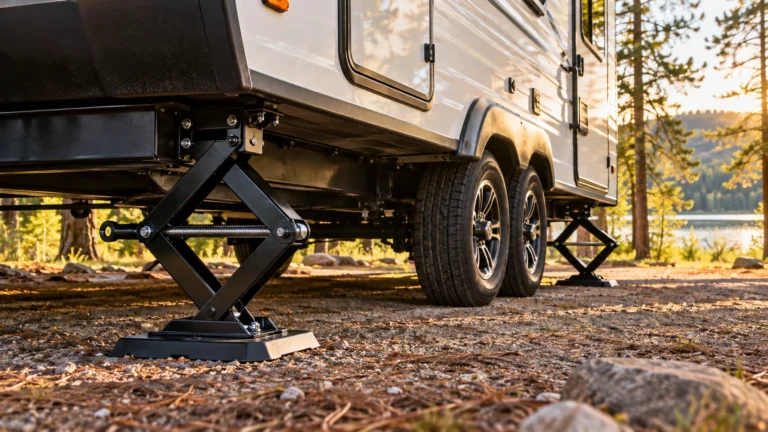
A ground-contact wedge is intended to resist rolling. An expanding device installed between two tandem tires is primarily designed to reduce tire movement and RV rocking. Camco’s own Wheel Stop instructions explicitly say to use brakes and wheel chocks to secure a vehicle; the between-tire device is not a replacement. Stabilizer jacks have a different job again: reducing frame movement after the RV is already parked and secured.
If your problem is the trailer creeping while you unhitch, buy and correctly place ground-contact wheel chocks. If your trailer is already safely chocked but feels bouncy when someone walks inside, investigate stabilizers separately. This guide deliberately does not rank X-chock models because they solve a different purchase decision.
When not to buy any of these three
Skip all three if the tire is outside the published fit limits, the manufacturer cannot verify suitability for your RV and parking conditions, or you need an identified working-load and incline specification. A large fifth wheel, oversize motorhome tires, commercial vehicle, unusual slope or unstable ground should trigger a specification-driven search, not a default order of the most popular campground wedge.
Inspect chocks before each use. Cracks, deformation, damaged pull ropes, worn gripping surfaces or contaminated/unstable ground contact are reasons to replace the unit or change the setup. Keep the product instructions with your hitching checklist so that the right equipment is used the same way by everyone who parks the rig.
Our choice: start with the MaxxHaul 70472 if a robust rubber two-pack matches your verified tire and surface requirements. Pick the Camco 44471 when low bulk and retrieval ropes matter and your tires are no more than 26 inches. Choose the Camco 44492 only when you need its larger stated 29-inch tire range and have accounted for its single-unit packaging. Choose none of them if the relevant fit and safety limits are not documented for your rig.
How we selected these RV chocks
This is a research-based product comparison, not a report of hands-on testing. The selection uses each maker’s product specifications or catalog, model-specific Amazon US listings, and manufacturer chocking warnings. We prioritized actual fit boundaries, package quantities and material differences. We excluded expandable tandem-wheel stabilizers from the product rankings and did not infer vehicle-load ratings or weather performance from sales copy or customer star counts. Availability and listing variations can change, so recheck the exact model and included quantity before ordering.
Frequently Asked Questions
How many wheel chocks should I carry for a travel trailer?
Carry enough individual wedges to follow your trailer manufacturer’s parking instructions for the situations you encounter. If your procedure calls for front-and-back restraint on tires on both sides, that may require four separate wedges. Remember that a single Camco 44492 package contains one chock, while the MaxxHaul 70472 and Camco 44471 packages discussed here each contain two.
Can I use wheel chocks on a campsite that slopes downhill?
Only if your RV maker permits the parking situation and the chocks are rated or otherwise specified as suitable for the vehicle and grade. Do not assume any universal safe slope based on rubber versus plastic or a “heavy-duty” label. Choose a safer location if the grade or ground conditions cannot be secured using manufacturer-approved equipment.
Can a 15-inch RV tire use Camco’s 26-inch chocks?
Not necessarily. Fifteen inches typically identifies the rim diameter, not the entire tire’s outside diameter. Look up the exact tire model and size, then compare its overall diameter with the Camco 44471’s stated maximum of 26 inches. If it exceeds that figure, choose a different properly specified chock.
Do wheel chocks remain safe after a vehicle runs over them?
Do not keep using a chock that is cracked, distorted or otherwise damaged. Manufacturers instruct users not to drive over wheel chocks; even apparently minor distortion can change the shape of the contact surface. Inspect the entire block and discard it when there is doubt about its integrity rather than assuming it will perform normally.