
GearAndRig is reader-supported. As an Amazon Associate I earn from qualifying purchases. When you buy through links on our site, we may earn an affiliate commission, at no extra cost to you. Learn more.
If your RV surge protector shows a fault or refuses to send power to the trailer, check the campground pedestal and the device’s exact error message before blaming the protector. A full electrical management system (EMS) may be doing its job by blocking unsafe shore power. Start with the breaker, visible connections, and the manufacturer’s reset delay. Never bypass a reported wiring fault just to get the air conditioner running.
Start with the safe checks, not a replacement
There are three different problems that can look identical from inside the RV: no usable power reaching the protector, a protector deliberately refusing to pass power, or a fault downstream in the RV. The display or status lights help distinguish them, but they do not give you permission to work on a live pedestal.
- Stop immediately if anything looks or smells overheated. Scorched blades, softened plastic, crackling, smoke, moisture inside a connector, or a hot, discolored receptacle call for disconnecting at the breaker when safe and asking campground staff or a qualified electrician for help. Do not handle damaged energized plugs.
- Check the pedestal breaker position. With the RV’s heavy loads switched off, confirm that the correct campground breaker is on. Some breakers must first be moved fully to OFF before they can be reset. If it trips again, stop. Do not repeatedly reset it.
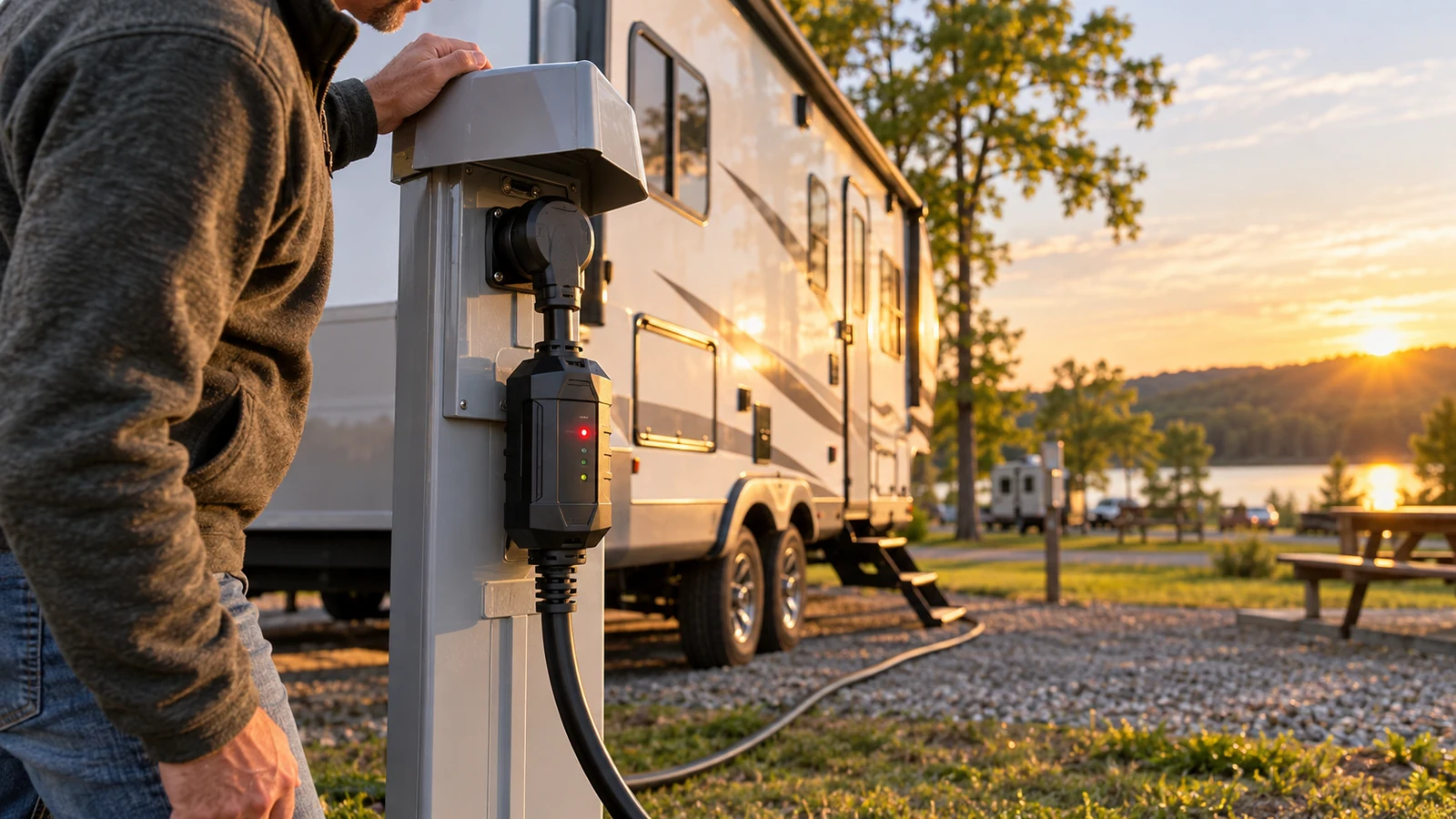
- Read the protector before making changes. Record the exact model, displayed code or LED pattern, line voltage if shown, and whether a delay/countdown is active. On a 50-amp EMS, note whether the display identifies line 1 or line 2.
- Check only the accessible, de-energized connections. With the pedestal breaker off, visually inspect a removable power cord, adapter, and protector for obvious damage or a loose fit. If an outlet or cord is questionable, have staff inspect it. Never open the pedestal, probe exposed conductors, or modify grounding.
Then choose the symptom below. If a known-good, correctly rated pedestal is available, the campground or a professional can help compare behavior at a second source. Progressive Industries specifically recommends checking more than one source before treating the protector as defective. That is a diagnostic comparison, not a reason to ignore a fault code.
Which symptom do you have?
| What you see | Most useful first check | What it does not prove |
|---|---|---|
| Display and LEDs completely dark | Pedestal breaker, power availability, and intact plug connection | A dark screen alone does not prove the surge module failed |
| Display lit, fault shown, no RV power | Exact code in that model’s manual; report the supply fault | The protector is not necessarily broken |
| Normal status, but RV remains dark | Allow the model’s delay; then check the RV’s AC main breaker | A normal code is not proof that all downstream wiring is good |
| Power comes on, then drops when A/C starts | Low incoming voltage under load, excessive load, or poor connection | It is not automatically an undersized or defective protector |
| Surge-protection-failed indication | Manufacturer’s module replacement or service instructions | Passing electricity does not mean surge protection remains intact |
If the display is dark at an otherwise functioning campsite, ask staff to confirm that the outlet is energized and correctly wired. If power is present at a verified source but the protector still has no lights, contact the device manufacturer. A defective internal display and a defective protection circuit are not the same diagnosis.
The protector has lights, but the RV has no power
A startup or reconnection delay may still be running
Some EMS devices intentionally wait before reconnecting the RV, particularly after a fault, to avoid rapid cycling of equipment such as an air conditioner compressor. That delay is not universal. Progressive Industries EMS-PT models describe a time-delay cycle; Southwire’s 34930 documentation distinguishes a short initial check from a longer restart delay after certain voltage faults; Power Watchdog EPO materials describe automatic restoration after conditions stabilize. Follow the exact manual and screen indication rather than unplugging and replugging every few seconds.
Watch the countdown if present. If the device is displaying an active fault, waiting alone will not correct the underlying problem. When a model reports normal input but the coach is still dark after the documented delay, check the RV’s accessible AC main breaker and shore-power selection settings. Some motorhomes use an automatic transfer switch; a fault there requires a qualified RV technician.
No error code is not the same as power delivery
Progressive documentation treats an E0 as a normal condition, but separately instructs owners to contact technical support when the display reads E0 and power still does not reach the coach after the delay. This is a useful dividing line: once an EMS says the input is acceptable, the next question is whether it has closed its power path and whether the RV can accept power. Do not open a hardwired EMS cabinet or jumper its contacts.
Read the error code using your brand and model
An E-code is not a universal RV electrical language. A code used by one brand can mean something else on another, and even generations within a brand may differ. The table below is a Progressive Industries EMS example based on its published EMS documentation, not a cross-brand decoder.
| Progressive EMS display | Typical meaning in the cited EMS-PT/HW family | Safe response |
|---|---|---|
| E0 | Normal input condition | Wait for the model-specific delay; investigate the RV side if power never arrives |
| E1 | Reverse polarity | Do not use that source; have campground staff correct the wiring |
| E2 | Open ground | Stop and report it; do not defeat ground protection |
| E3 / E4 | Line 1 high / low voltage | Stop large loads and ask for an electrical supply check |
| E5 / E6 | Line 2 high / low voltage on applicable 50A models | Report which line is affected; do not assume the other leg makes the pedestal safe |
| E7 / E8 | Frequency fault in certain Progressive EMS manuals | Use the exact model’s chart and call support as directed |
| E10 | Surge element/module needs attention after a surge event in relevant manuals | Arrange manufacturer-approved service or replacement; do not treat it as fully surge-protected |
| PE followed by a number | Previous error on models that store fault history | Record it even if current status has returned to E0 |
Important model distinction: Progressive has published different error charts over time. Its newer general troubleshooting guidance calls E10 a surge occurrence and warns that further surge protection may be lost; older EMS manuals call for replacing the surge protector module. Some older hardwired units also use E9 for a display/data-link fault. Confirm the document for your specific device before interpreting a code, particularly E8 through E10.
Southwire Surge Guard uses different messages
Southwire models such as the 34930 use an LCD to show conditions including low or high line voltage and reverse polarity. Its troubleshooting guide warns that a unit which initially powers the coach but switches off shortly afterward may be responding to voltage that falls when loads are applied. The correct next step is to reduce load, report the fault, and have power checked, not to bypass the device. Startup and reset times differ by model and circumstance.
Power Watchdog: check EPO, generation, and the app
On a Power Watchdog, first determine whether you have the EPO automatic-shutoff version or a base surge-monitoring model. The manufacturer says the base models can warn about certain bad power conditions without automatically disconnecting the RV. Gen I and Gen II Watchdogs also use different phone apps. A Bluetooth pairing failure therefore does not necessarily indicate that shore-power protection has failed.
Power Watchdog’s current FAQ identifies E9 on the relevant EPO/Gen II models as a spent surge module signal. That is a different meaning from Progressive’s model-specific E9 descriptions. Never act on a bare code copied from a different brand’s forum post.
Why power keeps cutting out when appliances start
If the EMS closes its output, the RV powers up, and everything drops as soon as the air conditioner, water heater, or another large load starts, record the voltage reading before and during that event if your protector safely displays it. A marginal pedestal connection or overloaded campground circuit can have normal-looking voltage with little load and sag when a compressor starts.
The manufacturer’s cutoffs are not interchangeable. For example, Progressive documentation describes low-voltage intervention around 104V on specific EMS models, while some Southwire literature uses a different threshold and timing. Treat those as device settings, not a universal test that any 103V connection is safe. If the display indicates undervoltage, switch off major loads and request a park electrical check. Do not defeat the cutoff to force a compressor to run.
Other possibilities include a pedestal breaker that trips under load, a failing connection that heats up, or an RV-side appliance or branch-circuit problem. A breaker trip and an EMS protective shutdown require different responses. If the breaker is tripping, an electrician should verify the circuit and load; repeated resets are not troubleshooting. If the EMS is cutting off with a line-voltage code, focus on shore-power quality instead of buying another EMS blindly.
When the trouble began after changing a pedestal, adapter, or generator
A 30-amp RV shore-power connection normally uses 120V service; a 50-amp RV connection uses a 120/240V split-phase arrangement. Neither an ordinary dogbone adapter nor a surge protector converts a truly incompatible voltage source into the correct supply. A 30-amp trailer plugged into an incorrectly wired 240V outlet can be damaged even if the plug arrangement seems to fit. Have a qualified electrician identify the supply before using unfamiliar wiring.
Some generators use a floating neutral, which may trigger an open-ground or bonding-related message on certain protection devices. That is a wiring-system compatibility issue, not evidence that ground-fault safety should be defeated. Consult both the generator and EMS manufacturers and a qualified electrician before any neutral-ground bonding change. Do not install a makeshift jumper or use a bypass plug suggested for a different generator.
Adapters and extension cords introduce another connection that can loosen, heat, or create voltage drop. If the problem only occurs through an adapter, stop using any damaged adapter and verify its rating and wiring with the manufacturer or a professional. Avoid drawing a full RV load from a limited household outlet simply because the plugs can be adapted.
When repair or replacement makes more sense
Do not replace an EMS because it accurately reports a bad campsite pedestal. Consider service or a replacement only after the source has been professionally verified, the correct delay has elapsed, and the model’s manual or manufacturer support points toward a hardware fault. A melted plug, cracked housing, water intrusion, a persistently dead unit on verified power, or a spent surge-protection indicator changes the decision. Stop using visibly damaged hardware.
For a replaceable surge module, follow the exact generation-specific procedure; not every EMS has a user-replaceable module. A surge module can be spent while the device still passes power or continues monitoring, so a lit display is not proof that surge suppression is intact.
If replacement is genuinely required, match the RV’s 30A or 50A shore-power configuration and decide whether you need automatic over/under-voltage shutoff. Here are two verified Amazon.com model listings as reference points, not a recommendation to replace a working device:
Amazon listing availability and seller offers change. Neither listing should be treated as proof of a live offer, and you should not order a whole new unit until a repairable or warranty-covered fault has been ruled out.
What to tell the campground or manufacturer
A precise report gets you farther than saying the surge protector is broken. Record the model and amperage, current code and previous code if available, both line voltages on a 50A unit, whether the pedestal breaker tripped, whether the fault appears only under load, the adapter or generator in use, and what happens at a second verified source. Photograph the display from a safe position. For a persistent pedestal wiring fault, ask management to arrange an electrician; for normal verified input but no output, contact protector support with those readings. For RV-side power problems, use a qualified RV electrical technician.
Frequently Asked Questions
Why is my RV surge protector showing a green or normal status but I still have no power?
First allow the device’s documented startup delay to finish. A normal input reading does not confirm that the RV’s AC main breaker, transfer switch, or downstream equipment is working. If the protector has verified input and the delay has elapsed, follow its model-specific support procedure rather than bypassing it.
Can I plug the RV directly into the pedestal to find out whether the surge protector is bad?
Not when the protector reports unsafe wiring, voltage, grounding, or another active hazard. Bypassing it would expose the RV to the fault it detected. Ask campground staff to verify the supply independently and consult the protector maker before considering any controlled diagnosis at a known-good source.
Does a surge protector still work after a lightning-related surge or a surge-failure warning?
Do not assume so. Some devices continue displaying voltage or passing electricity after their surge-suppression element is depleted. The fix may be a manufacturer-approved module swap or service for the entire device, depending on its model and generation. Treat any failed surge-protection indication as a service issue.
Why does my Power Watchdog connect to power but not to the phone app?
Check the exact Watchdog model and generation before reinstalling the app. The manufacturer uses different apps for older standard, older EPO, and Gen II Wi-Fi models. A phone connection problem is separate from diagnosing whether the unit detects safe shore power or whether an EPO shutoff is active.