
GearAndRig is reader-supported. As an Amazon Associate I earn from qualifying purchases. When you buy through links on our site, we may earn an affiliate commission, at no extra cost to you. Learn more.
The best RV surge protector for most campers is a full electrical management system (EMS) that disconnects unsafe campground power, not a surge-only adapter with warning lights. For a 30-amp RV, start with the Progressive Industries EMS-PT30X. For a 50-amp RV, choose the EMS-PT50X. If phone monitoring matters, the 30-amp Hughes Power Watchdog PWD30-EPO adds Bluetooth and a replaceable surge module.
These recommendations are based on manufacturer specifications, instruction manuals, and current product identities, not hands-on testing. The right unit still depends on your RV’s shore-power plug, the protection functions you want, and how you prefer to read faults at the pedestal.
Quick picks: which RV surge protector fits your setup?
| RV and priority | Model | Deciding feature | Know before buying |
|---|---|---|---|
| 30A, straightforward protection | Progressive Industries EMS-PT30X | Automatic protection plus on-unit fault and electrical readings | Uses an initial/recovery delay; no phone app |
| 50A, two-leg shore power | Progressive Industries EMS-PT50X | Monitors both legs of a 50A hookup | Wrong plug type for a normal 30A RV without an appropriate adapter |
| 30A, phone readings and serviceable surge part | Hughes Power Watchdog PWD30-EPO | Bluetooth and replaceable surge module, with automatic shutoff | Must say EPO; the similar PWD30 does not shut off unsafe voltage |
| 30A, pedestal connection overheating concerns | Southwire Surge Guard 34930 | LCD readout and monitored plug/receptacle temperature | No Bluetooth; an exhausted surge section calls for unit replacement |
Start with the plug, not the brand. A 30A RV normally uses a three-prong TT-30 connection rated for 120V service. A 50A RV normally uses a four-prong 14-50 connection supplying two 120V legs. Those are different electrical services, not simply two levels of surge suppression. An adapter cannot increase the power a campground outlet can supply.
Four RV electrical protectors worth comparing
Progressive Industries EMS-PT30X: the uncomplicated 30A choice
Choose it if: your camper uses 30-amp shore power and you want the EMS to make the disconnect decision without relying on an app or a phone being nearby. Progressive’s manual documents protection against sustained high and low voltage, reverse polarity, open ground, open neutral, and certain abnormal-frequency conditions, as well as surge suppression.
The EMS-PT30X has a 1,790-joule published surge rating and an integrated display for voltage, current, frequency, and error history. That last point matters: a camper that loses power can check the fault code rather than assuming the pedestal breaker has tripped. Its manual describes a 136-second re-energizing delay, so waiting after a clean hookup or corrected fault is normal.
Skip it if: you require Bluetooth monitoring or a user-replaceable surge module. The manufacturer instructs owners to replace the protector if the surge section becomes exhausted; error E10 does not necessarily stop power from passing through. The weather-resistant enclosure is intended to hang vertically and not be submerged, and a cable lock is still worth considering at an exposed pedestal.
Progressive Industries EMS-PT50X: for a 50A motorhome or fifth wheel
Choose it if: the RV has a 50A, four-prong shore connection and you prefer a portable protector with a readout for both hot legs. The EMS-PT50X is not simply a higher-capacity version of the TT-30 plug: its monitoring includes separate line-voltage and current readings, and its fault codes can identify which leg has a high- or low-voltage problem.
Progressive specifies 3,580 joules of surge suppression for the 50A model and the same 136-second reconnection delay. A readable two-leg diagnostic is especially useful when part of the RV works but another circuit appears dead. An EMS code is a clue, though, not a substitute for a qualified electrician checking a suspect pedestal.
Skip it if: your RV is natively 30A and you are shopping purely because the 50A model advertises more joules. Matching the coach’s connection is the starting point; buying a mismatched plug merely to chase a larger joule number is not an upgrade. Like its 30A counterpart, this model has no built-in smartphone reporting.
Hughes Power Watchdog PWD30-EPO: for Bluetooth and a replaceable surge module
Choose it if: you have a 30A RV and want to see live voltage, amperage, and wattage from your phone while you are within Bluetooth range. The PWD30-EPO includes Emergency Power Off, allowing it to disconnect the RV when the manufacturer’s defined unsafe voltage or wiring conditions occur. Hughes lists a 3,000-joule surge rating, an IP65 enclosure rating, and a replaceable surge module.
There is an important buying trap here. PWD30 is not PWD30-EPO. The non-EPO version offers surge protection and monitoring, but Hughes says it does not automatically shut off high or low voltage. The presence of a wireless app, a bright faceplate, or a large joule rating does not make those two models interchangeable.
Skip it if: you do not want another app or prefer a straightforward built-in numeric display. Bluetooth is a convenience, not a requirement for the EPO safety functions to operate. Also check the surge-module status: Hughes notes that a depleted module may allow power to continue flowing while no longer providing surge suppression until the module is replaced.
Southwire Surge Guard 34930: for a monitored pedestal connection
Choose it if: you use 30A hookups, want on-device LCD readings, and especially value protection against an overheating plug or receptacle. Southwire lists high/low-voltage protection, open-ground and open-neutral protection, and temperature monitoring for model 34930. Its published surge rating is 2,450 joules; it has a 10-second startup sequence and a 128-second reset delay.
That temperature feature addresses a different failure mode from a brief incoming voltage spike. A worn or loose campsite receptacle can become hot even when the displayed voltage seems normal. Temperature sensing is not permission to use a visibly scorched, loose, wet, or damaged socket. Stop and ask campground management to correct the connection.
Skip it if: you want phone monitoring; Southwire’s 34930 is the non-wireless model, whereas nearby model numbers have different remote capabilities. The company’s troubleshooting document treats a spent surge section as a replace-unit condition. Confirm 34930 in the listing rather than assuming every Surge Guard labeled 30A has the same features.
What actually separates a good RV surge protector from a bad purchase?
Automatic shutoff matters more than a status light
A basic surge device can absorb certain short transients. Some versions also show a wiring-fault indicator. An EMS goes further: it continuously evaluates the incoming supply and can disconnect power for specified high/low-voltage and wiring faults. That is why the Progressive EMS models, Hughes EPO, and Southwire 34930 are the primary recommendations here, not inexpensive surge-only dogbones.
Do not assume that every fault has the same response time. For example, Progressive’s manual describes different shutoff timings across high-voltage ranges and a delay before reconnection. Always use the exact model’s manual and displayed code to understand its behavior.
Joules describe one specification, not total protection
A joule rating refers to surge energy absorption under a manufacturer’s stated conditions. It says little by itself about sustained undervoltage, open neutral, overheating connections, or whether the unit disconnects the RV. These products also differ in surge modes, electronics, and how the protective components can be serviced.
The practical ranking is: correct service rating, verified automatic fault response, readable diagnostics, safe physical fit, and maintainability. Use joules as a secondary comparison among otherwise suitable models, not as a reason to choose a surge-only monitor over an EMS.
Physical fit at the pedestal can make or break a trip
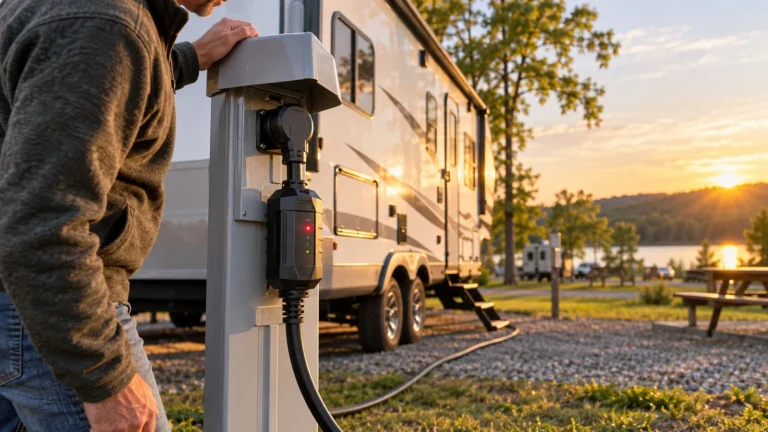
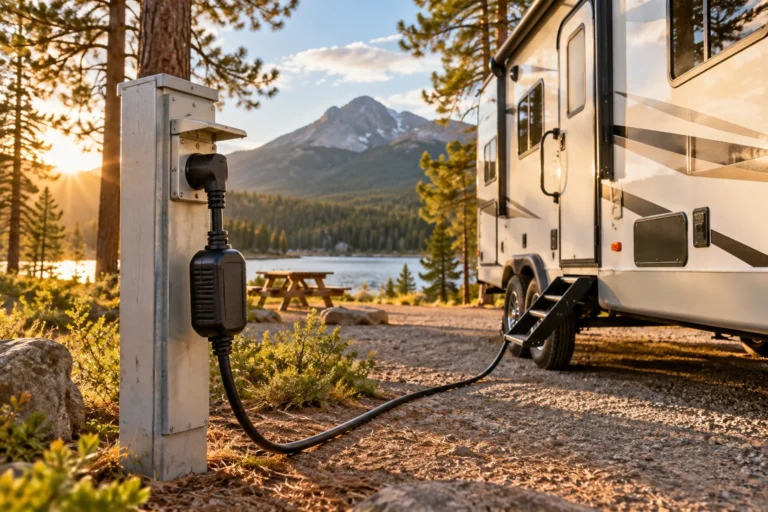
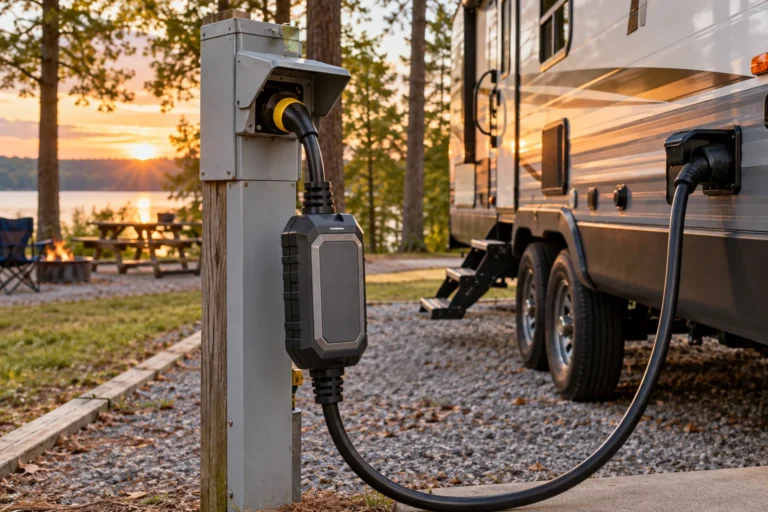
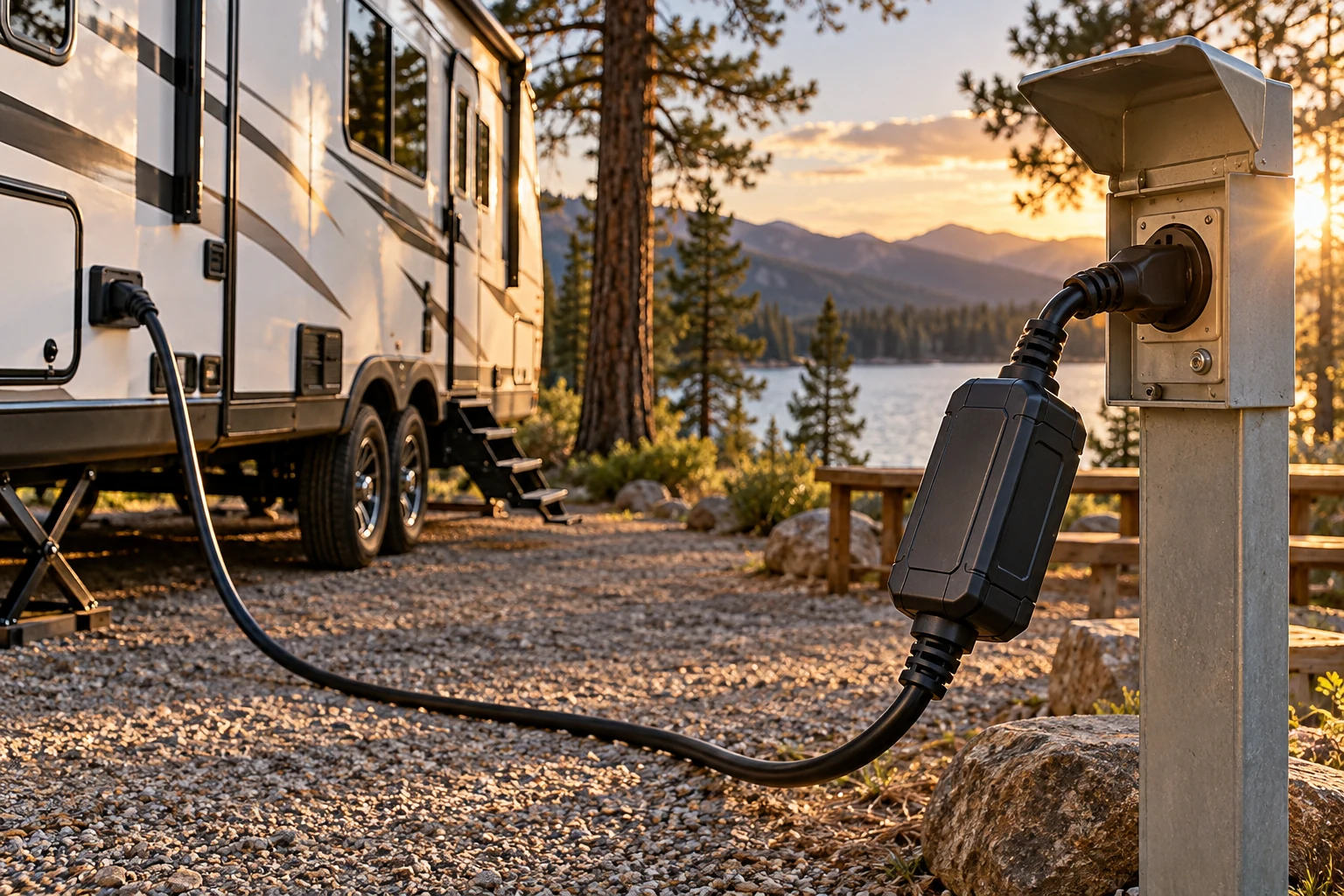
Picture a shallow campground electrical box with a downward-facing receptacle and a stiff RV cord. Even an excellent protector may hang awkwardly, stress the socket, or interfere with the pedestal lid. Look at your cord’s plug and outlet orientation, the protector’s hanging space, strain relief, weather precautions, and whether you can lock it without crushing the cable.
If the pedestal receptacle feels loose, has heat discoloration, or will not securely hold a plug, use another approved hookup after notifying the campground. A protector cannot make a physically defective connection safe. Never file, reshape, or modify a plug to force a fit.
Make the choice in three checks
- Confirm the RV inlet and shore cord. Read the RV’s power specification and identify TT-30 or 14-50. Choose a protector rated for that service. If using an approved adapter, the available current remains limited by the lower-rated source and RV; an adapter does not create extra capacity.
- Decide whether automatic disconnection is nonnegotiable. If you want protection from more than momentary spikes, select a clearly specified EMS or EPO model. For Hughes, verify the exact EPO suffix in the product listing and on the device.
- Pick your reporting and ownership tradeoff. Progressive favors built-in displays and detailed fault codes. Hughes adds Bluetooth and a replaceable surge module. Southwire 34930 adds receptacle over-temperature monitoring. None eliminates the need to inspect plugs or act on a fault.
Our decision: choose EMS-PT30X for a no-app 30A camper, EMS-PT50X for a 50A coach, PWD30-EPO if Bluetooth and a replaceable surge module will genuinely be used, or Surge Guard 34930 when monitored receptacle overheating is the priority. Choose none of these until you verify the RV’s shore-power rating and the exact listed model.
Before plugging in: an EMS is not permission to ignore a bad pedestal
Follow your RV and protector manufacturers’ connection sequence. Progressive’s portable EMS manual instructs users to turn off the pedestal, connect and energize the EMS first to read the pedestal condition, turn the supply off again before connecting the RV cord, and then restore power. Do not assume that sequence or fault codes are identical for every brand.
Before energizing, visually inspect the receptacle, EMS plugs, and RV cord for moisture, cracked insulation, burnt contacts, or signs of overheating. Keep portable units oriented as the manufacturer specifies and outside standing water. If the device reports open ground, reverse polarity, open neutral, abnormal voltage, or an overheated connector, do not bypass the protection to get the air conditioner running. Use a different safe hookup or have the campsite electrical equipment inspected by a qualified professional.
One often-missed detail: a device can continue passing power after its sacrificial surge components have been used up. The Progressive manual warns that E10 can indicate depleted surge protection while power remains on; Hughes similarly warns about exhausted Power Watchdog modules. A working microwave therefore does not prove that surge protection is still intact. Check the status indications described in the exact owner’s guide.
How these recommendations were evaluated
This is a specification-based buying guide, not a lab test or a claim of personal campground use. We compared manufacturer model pages and operating documents against the exact Amazon.com listings, emphasizing shutoff behavior, amperage fit, fault visibility, and maintenance consequences. Models that only show warning lights were not presented as equivalent to automatic-disconnect EMS units.
Availability and listing variants can change. At checkout, match the complete model number and shore-power connector shown in the listing to the product described above; do not rely on a broad listing title alone. If the correct version has no offer, avoid substituting a non-EPO model or another amperage without reviewing its functions.
Frequently Asked Questions
What does an RV surge protector do that the campground breaker does not?
A campsite breaker is primarily an overcurrent device. A full RV EMS also watches for specified unsafe voltage and wiring conditions and can disconnect the coach even when current is below the breaker rating. A surge-only adapter is not equivalent to an EMS, so read the exact product’s automatic-shutoff specifications before buying.
Can a 50-amp RV surge protector be used on a 30-amp pedestal?
Some manufacturer-approved setups can use the appropriate adapter, and Progressive’s EMS manual discusses operation with correctly rated adapters. That does not turn a 30A supply into 50A service. The pedestal, adapter, shore cord, and RV determine the safe current limit. Check your particular RV and EMS instructions before using adapters.
Why does my EMS show an error even though other campground outlets work?
The device may be detecting a wiring, grounding, neutral, voltage, or connection-temperature issue specific to your pedestal. Record the exact model and displayed code, switch off the source as instructed, and have campground management or a qualified electrician inspect the connection. Do not force power through a bypass merely because a neighboring site has electricity.
Will an RV surge protector save my RV from a direct lightning strike?
No portable surge protector can guarantee protection from a direct lightning strike. Published joule ratings are not a promise of survival under every lightning event. Disconnect shore power when appropriate under the campground’s severe-weather instructions; never handle cables or a pedestal during an active lightning hazard.