
GearAndRig is reader-supported. As an Amazon Associate I earn from qualifying purchases. When you buy through links on our site, we may earn an affiliate commission, at no extra cost to you. Learn more.
If your RV water pump keeps running after you close every faucet, turn the pump switch off before troubleshooting. The system may be losing pressure through a leak, drawing air through a loose inlet connection, struggling with a restricted supply, or failing to reach the pressure switch’s shutoff point. Start with the water supply and plumbing; replacing the pump should be a later decision, not the first one.
First, identify what the pump is actually doing
A demand-type RV pump normally runs when a faucet, shower, or toilet draws water and stops when the plumbing reaches its shutoff pressure. These four symptoms look similar from inside the RV, but they lead to different checks.
| What you notice | Most useful first check | What it suggests |
|---|---|---|
| Runs continuously with every faucet closed | Look for an open fixture, loss of water, or a suction/pressure problem. | The pump may be unable to build or recognize shutoff pressure. |
| Stops, then starts briefly every few minutes | Inspect hidden drips, toilet valve, and fresh-tank backflow. | Pressure is being lost after the pump stops; a leaking check valve is one possibility. |
| Motor runs but water sputters or barely flows | Confirm water in the tank, the selected valve positions, and the inlet strainer. | A priming, air-entry, or restricted-inlet problem is more likely than a faucet leak alone. |
| Motor runs despite the wall pump switch being off | Stop troubleshooting with the plumbing alone; isolate pump power safely. | Switch, controller, relay, or wiring diagnosis is needed. |
A useful distinction: a pump that cycles briefly is not necessarily defective. It may be doing exactly what its pressure switch requires because the plumbing cannot hold pressure. Continuous running is different: the system is not getting to the point where the switch tells the motor to stop.
Try these safe checks in order
Work with the pump off between observations. If you see a growing leak, wet wiring, smoke, or smell something overheating, stop and disconnect the relevant power supply only if you can do so safely. Do not leave an unexpectedly running pump unattended.
1. Check the fresh tank and the water-system mode
Confirm the tank contains water rather than trusting a possibly inaccurate level display. If you have recently winterized or filled the tank, check that the winterizing suction valve, tank-fill/diverter valve, low-point drains, and water-heater bypass are set for the operating mode described in your RV owner’s manual. A valve that feeds air or routes water away from the fixtures can leave the pump running without making usable pressure.
If connected to campground city water, the onboard pump generally does not need to run. Turn its switch off and observe whether the fresh tank unexpectedly fills. Tank overfilling on city water can point toward a fill/diverter valve left open or a pump check valve allowing backflow. Those faults should be distinguished before a replacement is ordered.
2. Close every water outlet, including the easy-to-miss ones
Make sure both kitchen and bathroom taps are closed. Check the outside shower, spray port, toilet flush valve, any connected washer, and the shower’s separate flow-control button. A showerhead button may stop spray while the mixing taps remain open; the pump still sees demand or pressure loss.
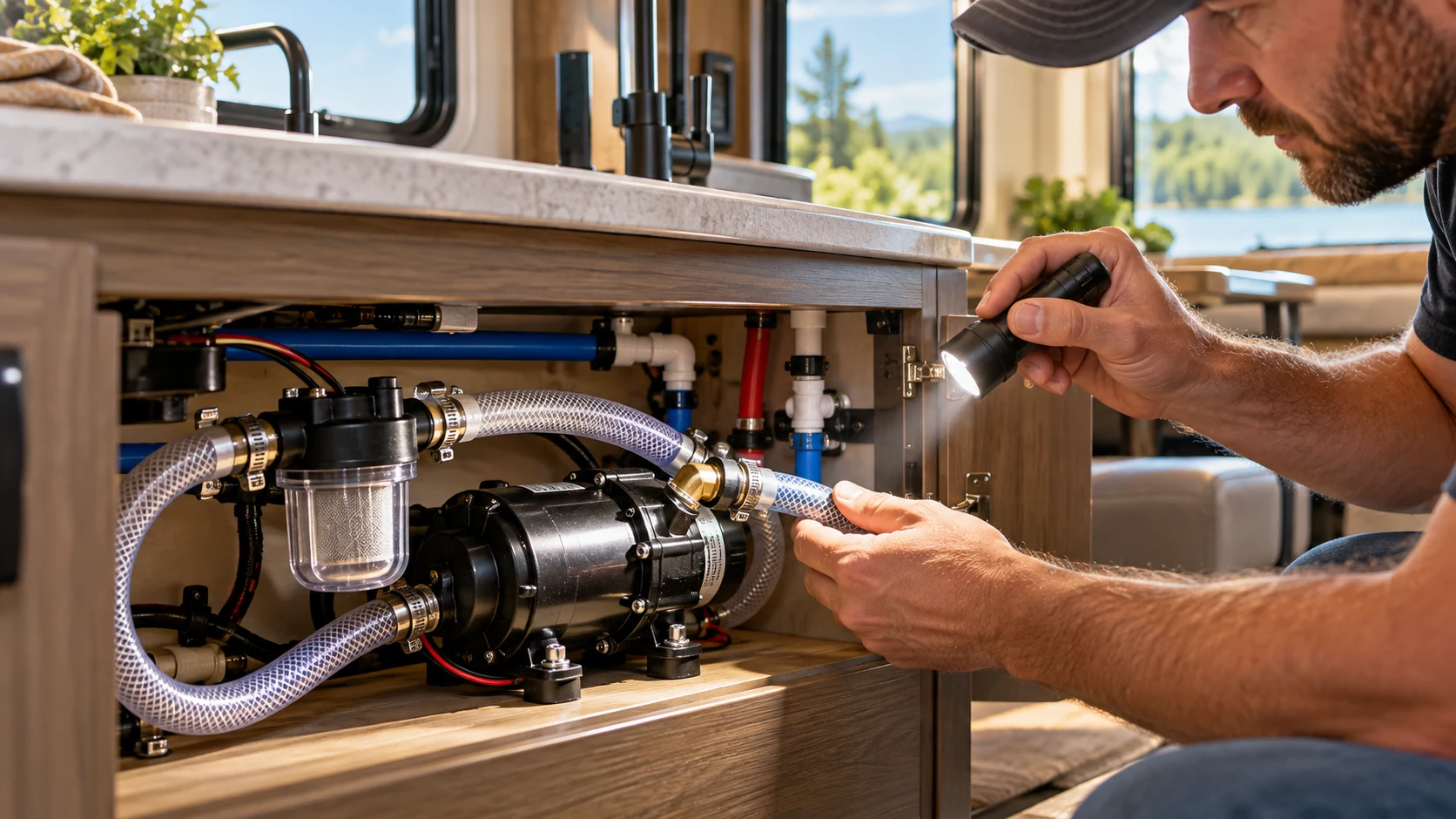
Inspect around the toilet, under sinks, behind accessible service panels, at the water heater, and near the pump. Feel for damp flooring and look for a wet supply line. A small toilet-valve seep or a hidden connection leak may not make an obvious puddle where you first look.
3. Inspect the pump’s inlet strainer and suction connections
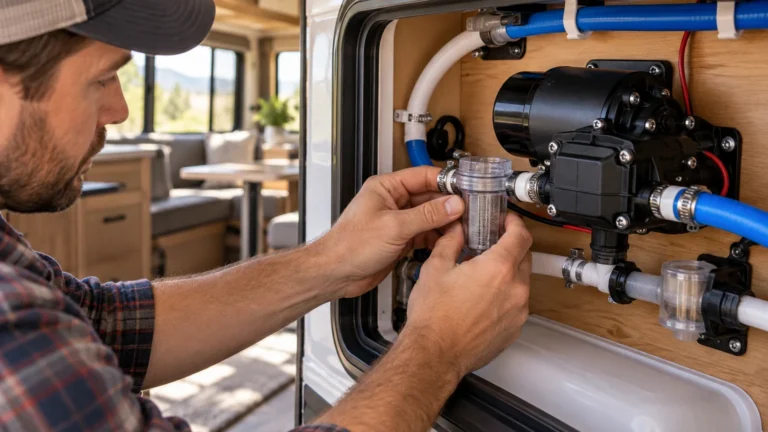
Switch the pump off, relieve system pressure at a faucet, and follow the pump manufacturer’s service procedure before opening an inlet strainer. A blocked screen can limit flow; a cracked clear bowl, missing seal, loose fitting, or suction hose can admit air even when no water leaks onto the floor. Look for visible debris, damaged seals, kinks, and disturbed fittings.
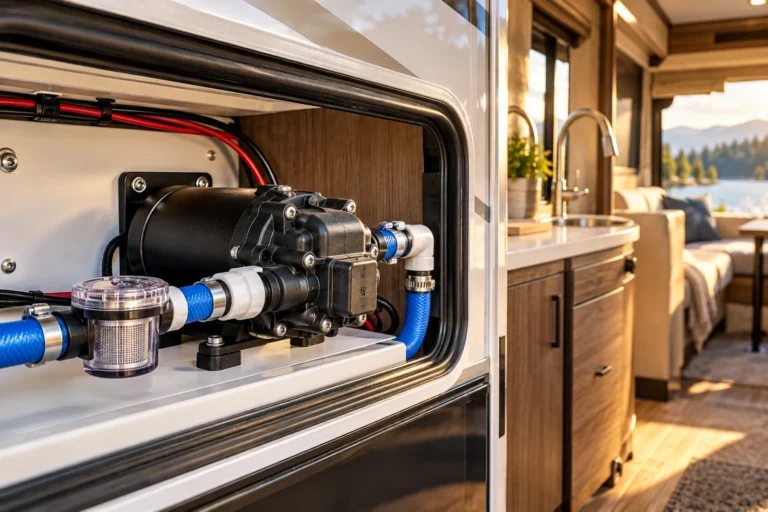
The SHURFLO 4008 installation manual specifically calls for an inlet strainer and identifies inlet air leaks, restrictions, and debris as pump-performance concerns. Clean a serviceable strainer if it is intact. Replace it only if its housing or seal is damaged or the existing screen is incompatible. Check the fitting style and available clearance before purchasing a replacement.
4. Clear trapped air without running the pump indefinitely
After a tank refill or plumbing service, air may remain in the pump head, water heater, or supply lines. With water confirmed in the tank and the system in its normal operating mode, open an appropriate cold-water faucet and follow the pump manual’s priming or air-purging procedure. Repeat at other fixtures as specified by the RV or pump manufacturer. Stop if water does not arrive or the pump continues struggling; a dry inlet or faulty valve will not be cured by prolonged running.
Persistent sputtering after air has been cleared is a reason to return to the inlet plumbing, rather than immediately adjusting the pressure switch.
5. Check for a power problem or an internal pump fault
If supply and plumbing checks do not explain it, note the full model number from the pump label. For the SHURFLO 4008 family, the manufacturer lists incorrect operating voltage, loose pump-head or drive components, debris holding internal valves open, and pressure switch/bypass interaction among the causes of failure to shut off. These are not interchangeable diagnoses.
Electrical voltage tests at a running pump and changes to the switch or bypass setting should be performed only by someone qualified and equipped to follow the exact manual. SHURFLO warns that improper bypass adjustment can prevent the pump from shutting off at all. Avoid the tempting internet fix of turning an unmarked adjustment screw until the motor goes quiet; it may conceal a leak or create a new pressure problem.
What if the pump keeps running but you cannot find a leak?
No visible puddle does not prove the plumbing is sealed. The water can escape inside a wall, through a toilet valve, into a water heater fitting, or backward toward the fresh tank. Air can also enter the suction side without leaving a water stain. Your next clue is whether water delivery is otherwise normal.
- Normal flow, motor never shuts off: first recheck unnoticed fixtures and pressure-side leaks. If those are ruled out, the shutoff switch, internal valves, or bypass setting becomes a stronger suspect.
- Weak flow or sputtering: investigate tank supply, winterizing valves, inlet restriction, suction air entry, and priming before considering the pressure switch.
- Good flow followed by periodic short runs: concentrate on pressure loss after shutdown, including small leaks and check-valve backflow. This is cycling rather than continuous running.
- Only fails after an earlier pump replacement: compare the exact old and new models, plumbing routing, connections, supply voltage, and installation instructions. A new pump does not rule out an installation or compatibility error.
Where accessible, a qualified RV technician can isolate parts of the water circuit and measure pressure and voltage rather than guessing. Do not clamp unfamiliar tubing, obstruct relief devices, or operate a pressure pump against closed or altered plumbing as a diagnostic shortcut.
When a part makes sense, and when it doesn’t
Buy only for a defect you have reasonably identified. A new pump will not repair a leaking faucet or a wrongly positioned winterizing valve. A clean strainer will not solve a defective switch or a leak on the pressurized side.
For a damaged inlet strainer: SHURFLO 255-313
The SHURFLO 255-313 twist-on pipe strainer is a relevant part to investigate if your installed strainer is cracked, leaking air at its housing, or no longer seals correctly. The existing strainer may need only cleaning, so inspect it before spending anything. Confirm the strainer model, thread/port configuration, pump compatibility, and service clearance against your actual plumbing; a SHURFLO-branded part is not automatically interchangeable with every RV pump.
For a confirmed failed pump: SHURFLO Revolution 4008-101-E65
If the pump has a documented internal failure and repair is not appropriate, the SHURFLO 4008-101-E65 is a 12-volt RV demand pump listed at 3.0 GPM with a 55-psi shutoff setting. It is not a universal replacement. Match the entire original model identifier, electrical supply, fuse/circuit requirements, shutoff setting, physical mounting, inlet/outlet connections, and plumbing-system limits. An apparent 4008 match can still be wrong for a particular OEM installation.
Our decision rule: clean or correct the existing setup when the problem is a valve position, restriction, loose suction fitting, or trapped air. Replace a specific damaged fitting or strainer when its failure is established. Consider a whole pump only after electrical, pressure, and plumbing causes have been separated and the replacement specifications verified.
When to stop troubleshooting and call an RV technician
Get professional help if the pump stays energized with its control switched off, electrical components are wet, there is evidence of hidden water damage, the motor is abnormally hot, or the pump cannot shut off after supply and fixture checks. A technician is also the right choice for pressure-switch/bypass adjustments that require calibrated gauges, wiring faults, or a system that still loses pressure with no accessible source of leakage.
For the next visit, record whether the pump runs without stopping or merely restarts periodically, whether faucets deliver steady water, whether you are using city water or the onboard tank, and the pump model number. Those observations narrow the diagnosis more effectively than buying a pump based on the noise alone.
Frequently Asked Questions
Can an RV water pump run continuously even when no water is leaking?
Yes. A blocked inlet strainer, air entering a suction connection, trapped air after plumbing service, low supply voltage, or an internal valve or pressure-switch fault can prevent the pump from reaching its shutoff condition. Check water delivery and the inlet side before assuming a concealed pressure-side leak.
Why does my RV pump run for a few seconds when all faucets are closed?
Short restarts after the pump has stopped usually indicate pressure is bleeding away. Inspect fixture valves, toilet supply, hidden drips, and potential backflow toward the tank. That pattern is different from a motor that never stops running, so it should not automatically trigger a pressure-switch adjustment.
Should the RV water pump be on when connected to city water?
In a typical RV hookup, city water supplies the plumbing directly and the onboard demand pump is switched off. If the pump operates with its switch off or the fresh tank begins filling unexpectedly, inspect the RV’s water-routing arrangement and have a qualified technician check for a controller, fill-valve, or check-valve fault as appropriate.
Will replacing the RV water pump fix a pump that won’t shut off?
Only if the pump itself is the confirmed problem. A new unit will still struggle with an empty tank, air entering the inlet, blocked plumbing, an open shower valve, or low voltage. Verify the exact pump model and all connection and electrical requirements before ordering another pump.