
GearAndRig is reader-supported. As an Amazon Associate I earn from qualifying purchases. When you buy through links on our site, we may earn an affiliate commission, at no extra cost to you. Learn more.
Start RV water pump troubleshooting with the symptom, not a replacement pump. If the motor runs but the faucets stay dry, check the fresh tank, valve positions, inlet strainer, and suction-side air leaks. If the motor is silent, check the switch and its 12-volt supply. A pump that cycles with every faucet closed calls for a different check: lost pressure or water leaking from the system.
Before You Blame the Pump: Four Checks
Most RV demand pumps draw from the onboard fresh-water tank. A pressurized campground hookup normally feeds the fixtures without requiring that pump. So first identify which water source you are testing. A working sink on city water proves that some downstream plumbing is usable; it does not prove the tank pump or its inlet line is healthy.
- Verify actual water in the fresh tank. If the monitor reading seems doubtful, confirm through the RV’s approved fill or inspection procedure rather than relying only on the gauge.
- Return the water-panel valves to normal tank-use positions. After winterizing, an antifreeze pickup valve left selected can make a healthy pump draw air from an empty hose. Follow your RV’s valve diagram, not a generic photo.
- Check a second fixture. A weak kitchen faucet with a normal bathroom faucet points toward a local aerator or branch restriction, not necessarily the pump.
- Look for water before operating further. A wet pump compartment, a dripping toilet valve, or moisture under the floor makes leak investigation more urgent than priming.
Safety first: Switch off the pump, disconnect city-water pressure, and relieve line pressure before opening a strainer or disconnecting a fitting. Keep electricity away from spilled water. Do not bypass an electrical protection device or adjust a pressure switch to compensate for an unknown fault.
Find Your Symptom
| What you notice | Check first | What changes the diagnosis |
|---|---|---|
| Motor runs; no water or only sputtering | Tank level, winterizing valve, inlet strainer, suction joints | Air getting into the pump inlet can prevent priming without leaving a puddle |
| No pump sound | Pump switch, 12V fuse or breaker, battery condition | A good fuse does not prove usable voltage reaches the motor |
| Weak flow or pulsing | Single fixture vs every fixture; aerators and restrictions | Whole-RV symptoms may involve inlet restriction, trapped air, or pump supply |
| Pump runs with all taps closed | Fixture leaks, toilet, line leaks, air pockets | If pressure cannot build, internal valves or the pressure switch may need diagnosis |
| Brief, unexpected pump starts | Slow leaks and pressure loss | A leaky internal check valve can mimic a hidden plumbing leak |
| New rattling or loud vibration | Clogged intake, mounts, hard plumbing contact | Noise alone is not proof the motor is failing |
The Pump Runs but No Water Comes Out
Follow the water’s path from the tank to the pump, then toward the faucets. This order separates a supply problem from an internal pump problem and keeps you from replacing a motor that still operates.
1. Confirm the pump is drawing from the tank
Inspect the fresh-tank outlet selection and any winterizing suction hose. A mispositioned valve can leave the pump connected to an empty antifreeze line. Check the RV owner’s diagram, particularly if this started after storage, sanitizing, or de-winterizing. A kinked intake hose or blocked tank pickup can produce the same symptom.
2. Inspect the inlet strainer and its seal
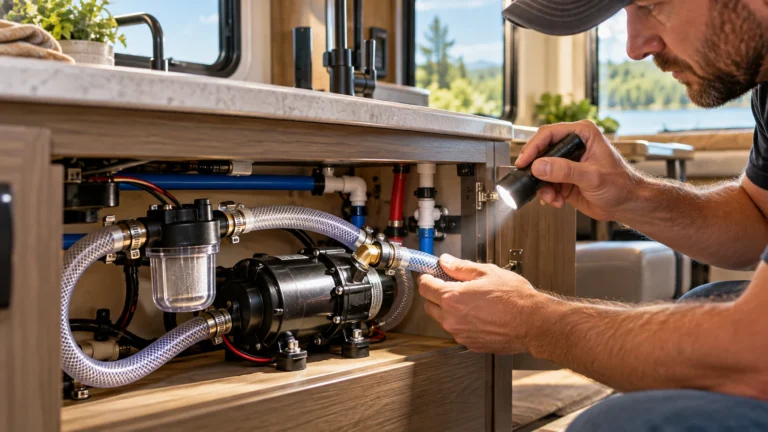
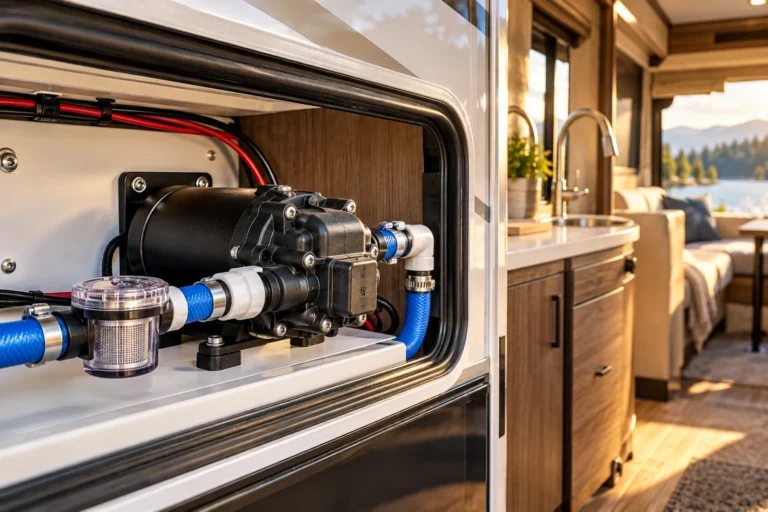
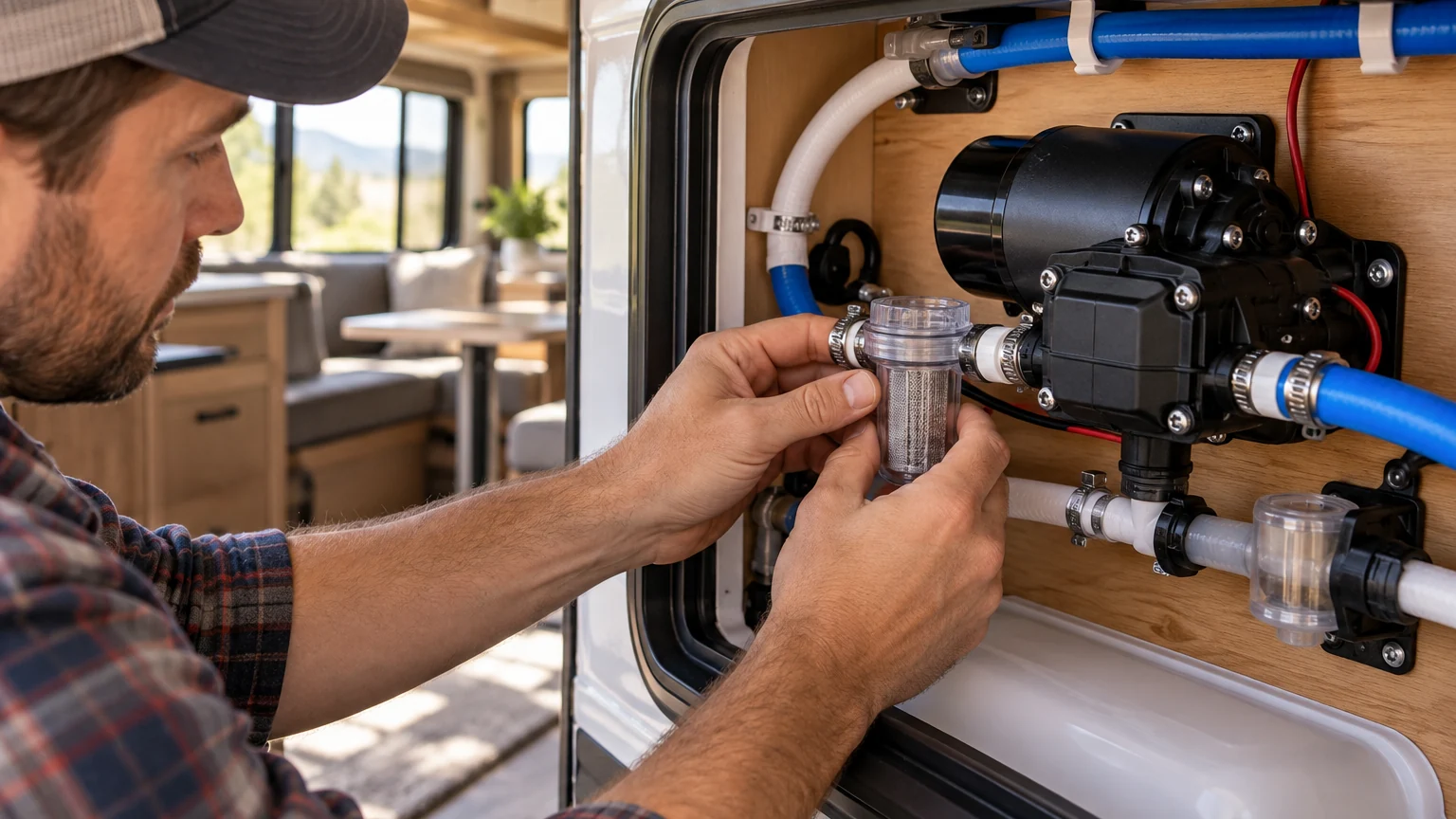
Many diaphragm-style RV pumps have a small transparent bowl or screen at the inlet. With power and water pressure isolated, inspect for sediment, a damaged bowl, a pinched seal, or a loose connection. Clean and reseat it according to the strainer manufacturer’s instructions. A suction fitting can admit air while the pump runs without visibly leaking water when the system is off.
3. Let trapped air escape, without running the pump indefinitely
With the tank supplied, valves correctly selected, and strainer reassembled, open a cold-water faucet and briefly operate the pump as the exact pump and RV manuals allow. The line may spit air before water arrives. If it still delivers nothing, stop rather than letting the motor run dry repeatedly. Check the inlet path again; manual priming and allowable dry-running periods vary by model.
4. Decide whether the pump itself needs service
If water is available at an unobstructed inlet but the pump still cannot build flow, the next suspects include debris in internal check valves, a worn diaphragm, a cracked housing, or inadequate supply voltage under load. The SHURFLO 4008 troubleshooting chart specifically includes those conditions. Internal disassembly and electrical tests should follow the exact model’s manual or go to a qualified RV technician.
Don’t confuse this with one dry faucet. If other faucets work normally, check the affected fixture’s aerator or valve before touching the pump.
The Pump Will Not Turn On
A silent pump is an electrical or control-path symptom until proven otherwise. Start with its accessible switch and correctly identified fuse or breaker. Some RVs have more than one pump switch, a controller, or a monitoring panel; confirm the actual pump circuit from the vehicle documentation.
If a fuse opens again after replacement with the manufacturer-specified type and rating, stop. Repeated resets are not a repair. A hot motor may also have opened a thermal protector, which can reset after cooling, but that does not tell you why it overheated. Low battery voltage, loose grounds, pressure-switch faults, and seized mechanical parts remain possible.
A technician can test voltage at the pump under operating demand and trace voltage drop or control failures. Do not jumper the pump directly across an unknown circuit, bypass the pressure switch, or substitute a larger fuse as a troubleshooting shortcut.
Low Pressure or Pulsing Water
First compare two fixtures with similar flow settings. If only the shower pulses, check its showerhead and hose for restrictions. If every faucet is weak, look for a clogged pump strainer, a partially closed valve, crushed tubing, air on the suction side, or low voltage reaching the pump. Those possibilities appear in official SHURFLO and Flojet troubleshooting guidance.
Rapid on-off cycling during a small draw can also result from restrictive fixtures or an improperly behaving pressure-control system. Some bypass-style pumps are intentionally designed to deliver low flow without rapid cycling. Avoid changing factory pressure settings unless the model documentation and a qualified technician call for it.
If pressure is normal using city water but poor using the tank, focus on the tank pickup, suction fittings, strainer, and demand pump. If pressure is poor under both sources, investigate common downstream lines and fixtures before condemning the pump.
The Pump Keeps Running or Starts When No Faucet Is Open
These are not quite the same failure. Continuous running suggests the system is not reaching shutoff pressure; occasional short starts suggest it builds pressure and then slowly loses it. Either way, inspect the toilet fill valve, faucets, exterior shower, low-point drains, and accessible pipe joints. A leak can be hidden inside a compartment or under a floor.
If no external leak is found, air trapped after refilling, debris in pump valves, internal leak-back, or a faulty pressure switch may be involved. The SHURFLO 4008 manual also warns that incorrect bypass and shutoff adjustments can prevent stopping. It specifically reserves bypass adjustment for technicians with gauges and suitable equipment.
If a fresh-water tank unexpectedly gains water while the RV is connected to city water, internal backflow through the pump check valve is one possible explanation. This is a separate clue from an ordinary leaky faucet, so document the behavior before purchasing parts.
Unusual Noise, Vibration, or Water Around the Pump
An intake restriction may make a pump noisy. So can a rigid pipe transmitting the motor’s normal motion through a cabinet. SHURFLO’s Revolution 4008 installation manual recommends flexible high-pressure hose on both ports, secure mounting, and a serviceable inlet strainer. Those are model-specific installation guidelines, not permission to rearrange unfamiliar plumbing without checking fit.
Water emerging from the pump head, switch body, or an apparently cracked housing is different from ordinary vibration. Shut off the pump and supply, dry the area, and check whether the leak comes from a fitting or the pump itself. Damaged housings and diaphragms need the appropriate manufacturer-approved service or replacement. Water near damaged wiring warrants professional attention.
One Part Worth Checking Before Buying a New Pump
The pump inlet strainer is a sensible first inspection because it can cause both poor flow and loss of prime. A cracked bowl or damaged seal may justify replacing that specific strainer rather than an otherwise serviceable pump. Cleaning debris from an intact assembly is often enough.
SHURFLO 255-313 Twist-On Pipe Strainer
Relevant when: your existing installation uses a compatible SHURFLO 255-series twist-on strainer with a 1/2-inch pipe inlet, and the strainer or seal is damaged. Pentair’s catalog identifies the 255-313 aftermarket pipe-inlet variant and its 50-mesh screen.
Skip it if: your system uses a hose-barb inlet, a different fitting style, or an unrelated filter. Match the exact existing part and port configuration before ordering. This strainer will not repair a failed motor, a leaking discharge line, or an electrical problem.
If checks point to an internal pump fault, compare the replacement against the old unit’s exact model, voltage, connectors, mounting, flow, pressure control, and electrical requirements. An apparently similar 12-volt RV pump is not automatically a drop-in replacement.
When to Stop Troubleshooting
Call an RV service professional if the pump repeatedly blows a fuse, the wiring is hot or wet, the motor is seized, the housing is cracked, a concealed water leak is spreading, or proper inlet supply and safe basic checks still produce no pressure. For a winter-freeze failure, inspect adjacent fittings and lines as well as the pump; replacing one component may leave another split section undiscovered.
The useful decision: A running motor with no water warrants an inlet and priming check first. A silent motor warrants a supply and control check. A pump that will not shut off warrants a leak and pressure-retention check. Buy a new pump only when those checks identify the pump rather than the surrounding system.
Frequently Asked Questions
Can an RV water pump fail even if its motor still makes noise?
Yes. The motor may turn while the pump fails to move water because of a blocked inlet, suction-side air leak, debris in its check valves, damaged diaphragm, or inadequate loaded voltage. Check the external water supply and inlet first; motor sound alone does not prove the pump has failed.
Why does my RV water pump act up after winterizing?
An antifreeze pickup valve can remain selected instead of the fresh tank, the pump may need to clear trapped air, or a strainer connection may be loose after service. Freeze damage is also possible if water remained in the system. Check valve positions and for leaks before assuming the motor failed.
Should the RV water pump be on while connected to city water?
Normally no. City-water pressure supplies the RV’s fixtures directly when the plumbing is set for that connection. The onboard demand pump generally draws from the fresh tank. If the plumbing has a specialized selector or fill arrangement, use the RV maker’s operating instructions.
Will any new water pump strainer fit my RV?
No. Strainers differ by inlet and outlet connection style, thread, seal, and geometry. For example, SHURFLO offers distinct pipe-inlet and hose-barb 255-series versions. Match the original strainer and pump port arrangement rather than choosing solely by the diameter in a listing title.